

Table of Contents
- Why Look for Alternatives to French Press for Bold Coffee
- The Boldness Spectrum: Matching Gear to Your Strength Preference
- AeroPress vs French Press: Immersion Brewing vs Pressure Brewing
- Pour-Over Methods for Flavor Clarity and Full-Bodied Coffee Brewing Techniques
- Moka Pot and Cold Brew: Pressure-Based and Time-Based Options
- Cleanup, Maintenance, and the Budget-to-Boldness Ratio
- Choosing the Best Coffee for Home Brewing with Your New Method
- Conclusion: Pick Your Bold Brew Path
- Frequently Asked Questions
Last Updated: September 17, 2026
Why Look for Alternatives to French Press for Bold Coffee
The French press is cheap and produces a heavy, sediment-rich cup, but the plunger leaves grit in your mug, cleanup is messy, and the brew is inconsistent. This guide breaks down alternatives to french press for bold coffee, ranked by how well each delivers body, richness, and strength without the sludge.
French press coffee is a full-immersion brewing method: coarse grounds steep in hot water for roughly four minutes before a metal mesh plunger separates the liquid from the spent grounds. That contact time extracts heavy oils and fine particles, producing the viscous mouthfeel and bitterness that define the style.
"Bold" and "muddy" are not the same thing. The best alternatives keep the richness while cutting the grit, and most cost less than a mid-range electric kettle. Below are five methods that match or beat the French press on boldness, plus a framework for matching gear to your strength preference.
The Boldness Spectrum: Matching Gear to Your Strength Preference
Boldness is shaped by three variables: extraction (soluble material pulled from the grounds), filtration (oil and sediment surviving into the cup), and concentration (water relative to coffee). A French press scores high on oil retention and moderate on concentration; an AeroPress scores high on concentration; cold brew concentrate scores highest on both.
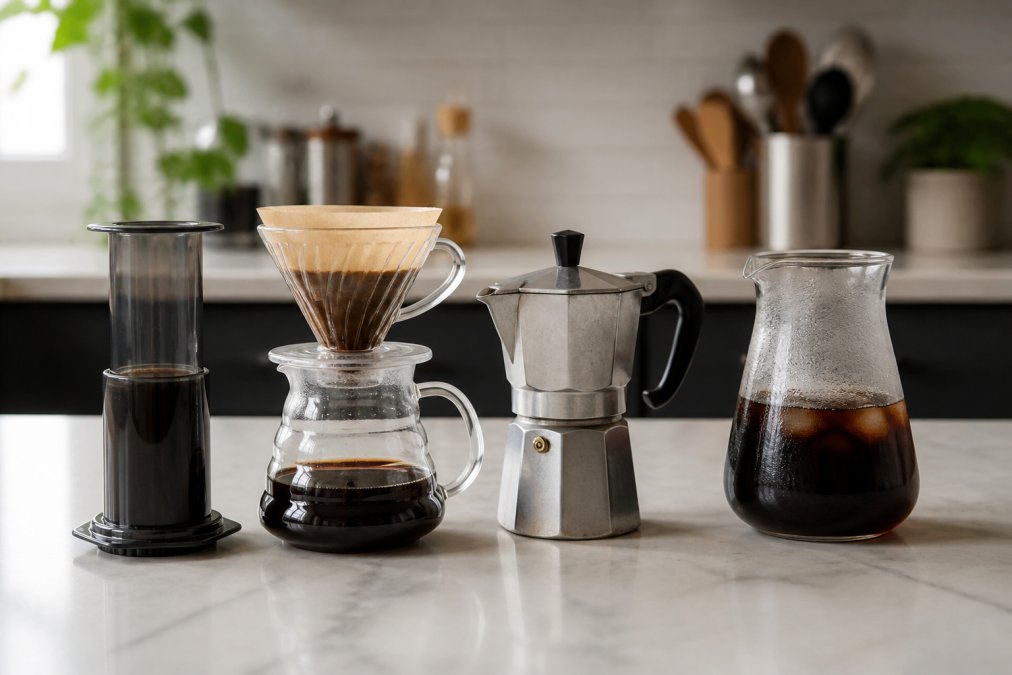
Here's how the major methods line up:
| Method | Body | Clarity | Brew Time | Cleanup Effort |
|---|---|---|---|---|
| French press | Heavy | Low (sediment) | 4 min | High |
| AeroPress | Medium-heavy | Medium | 1-2 min | Low |
| Pour-over | Light-medium | High | 3-4 min | Medium |
| Moka pot | Heavy | Medium | 5 min | Medium |
| Cold brew | Heavy | Medium-high | 12-18 hrs | Low |
AeroPress vs French Press: Immersion Brewing vs Pressure Brewing
The AeroPress wins the head-to-head for most drinkers who want bold coffee without the mess. It uses immersion brewing like the French press, but forces water through a paper or metal filter under hand pressure, cutting brew time to about 90 seconds and producing a concentrate you can dilute to taste. Where the French press gives a fixed-strength pot, the AeroPress gives you a dial: less water and a finer grind for more body, a paper filter for clarity, a metal filter and harder push for something closer to espresso.
Pour-Over Methods for Flavor Clarity and Full-Bodied Coffee Brewing Techniques
- Swap paper for metal mesh. A stainless cone filter (the Able Kone is the common reference point) passes oils and some fines that paper blocks. Expect a cup noticeably heavier than paper, but cleaner than a French press because the bed traps the largest particles.
- Grind finer than a standard pour-over recipe. Most guidance calls for a medium grind like coarse sand. Dropping to medium-fine, closer to table salt, slows flow and raises extraction, adding sweetness and weight. Go too fine and the bed stalls, the water channels, and you get a sour, uneven cup.
- Tighten the ratio. A typical pour-over runs 1:16 coffee-to-water. Moving to 1:14 or 1:13 concentrates the cup and reads as bolder without changing the brewer.
- Keep the bed deep and the water level high. A tall, narrow cone with a full water column maintains temperature and contact time better than a wide, shallow bed, which is why a V60 or Kalita Wave behaves differently from a flat-bottomed dripper at the same ratio.
- Control agitation. The bloom, the first pour that lets trapped CO2 escape, matters more here than with immersion. Dumping all the water at once channels the bed; a slow spiral pour from the center outward, pausing for the bloom, keeps extraction even.
Moka Pot and Cold Brew: Pressure-Based and Time-Based Options
The Moka pot is the closest thing to espresso without an espresso machine. Steam pressure pushes hot water up through a bed of grounds, producing a dense, syrupy shot with real bitterness and weight. It's stovetop, non-electric, and built from aluminum or stainless steel, so it travels well and lasts decades if you don't scorch it.
Cleanup, Maintenance, and the Budget-to-Boldness Ratio
Cleanup is where the French press loses the most ground, and why most people start searching for alternatives: wet grounds, a mesh screen that clogs with oils, and a carafe you can't put in the dishwasher without risking thermal shock. The hassle factor is the real decision variable, and it breaks down into three measurable parts: time per brew, consumable waste, and replacement parts.
| Method | Daily Cleanup | Consumable | Replacement Parts | Upfront Cost |
|---|---|---|---|---|
| AeroPress | ~15 seconds | Paper or metal filter | Plunger seal (years) | Moderate |
| Pour-over | 1-2 minutes | Paper filters (cents/cup) | None | Low |
| Moka pot | 2-3 minutes | None | Gasket (1-2 years) | Low |
| Cold brew | ~2 minutes per batch | Paper or cloth bag | None | Low-moderate |
- A cheap pour-over cone delivers clarity but not body, so boldness per dollar is low unless you commit to the metal-filter, tight-ratio approach above.
- An AeroPress costs more upfront but replaces both a French press and a drip machine for one or two drinkers, and its only recurring cost is filters. For a single drinker, the ratio is strong.
- A Moka pot is the cheapest route to genuine intensity. Upfront cost is low, there are no filters to buy, and the only recurring expense is a gasket every year or two.
- Cold brew has low daily hassle but a long lead time, so the ratio depends on whether you value convenience at the moment of brewing or across the week.
Choosing the Best Coffee for Home Brewing with Your New Method
The best coffee for home brewing is freshly roasted, correctly ground for your specific method, and matched to the body level you're chasing. Gear sets the ceiling; the beans decide whether you reach it.
- AeroPress: medium-fine, like table salt
- Pour-over: medium, like coarse sand
- Moka pot: fine, but not espresso-fine
- Cold brew: coarse, like raw sugar
Specialty Coffee Association brewing standards and resources
Conclusion: Pick Your Bold Brew Path
The French press isn't broken, but it isn't the only route to a heavy, rich cup, and for many drinkers it isn't the best one. Pick your path by what you value: an AeroPress for speed and control, a Moka pot for maximum intensity at minimum cost, cold brew for consistency across a long shift, and pour-over if you'll trade some body for flavor definition.
Frequently Asked Questions
What can I use instead of a French press to get bold coffee?
An AeroPress, Moka pot, or cold brew maker can all produce bold coffee without a French press. The AeroPress uses pressure to push water through a fine metal or paper filter, extracting a full-bodied cup with less sediment. A Moka pot relies on steam pressure for a concentrated, espresso-like result. Cold brew steeps coarse grounds for 12-24 hours, yielding a smooth, low-acid concentrate you dilute to taste. Each method offers a different balance of body, clarity, and cleanup effort.
Does an AeroPress produce coffee as bold as a French press?
Yes, and often bolder. The AeroPress uses pressure-based extraction with a fine filter, which can push more oils and soluble solids into the cup than a French press's metal mesh. The result is a full-bodied coffee with less grit and sediment. You control strength by adjusting the coffee-to-water ratio, brew time, and grind size. For a French press-style cup, use a coarser grind and a longer steep before pressing.
How does immersion brewing compare to pressure brewing for bold flavor?
Immersion brewing, like a French press, steeps grounds fully in water, extracting heavy oils and tannins for a rich, heavy body but often leaving sediment. Pressure brewing, like an AeroPress or Moka pot, forces water through the coffee bed quickly, producing a concentrated shot with more flavor clarity and less grit. Pressure methods tend to highlight acidity and nuance, while immersion methods emphasize richness and smoothness. Your choice depends on whether you prioritize body or clarity.
Which coffee makers are best for retaining natural oils?
Metal mesh filters, used in French presses and some pour-over setups, allow natural oils to pass into the cup, boosting body and richness. Paper filters trap most oils, giving a cleaner, lighter cup. The AeroPress with a metal filter, a Moka pot, and cold brew makers all retain oils well. If you want maximum oil retention without a French press, a Moka pot or AeroPress with a metal mesh filter is your best bet.
If your current setup leaves you choosing between bold flavor and a clean kitchen, the problem is usually the gear, not your standards. Mainline Roastery LLC roasts bold blends and single-origin beans fresh in Muscatine, Iowa, and delivers them fast enough that the oils are still there when you open the bag. Whether you're brewing for yourself or stocking a break room, you can get started with Mainline Roastery LLC and build a cup that actually holds up from the first pour to the last.