

Table of Contents
- Why French Press and Pour Over Produce Different Bold Flavor
- French Press vs Pour Over Comparison: Body, Clarity, and Oils
- Pour Over Coffee Clarity vs Body: What You Actually Taste
- The Best Coffee Grind Size for French Press (and Why Pour Over Differs)
- How to Brew Bold Coffee at Home: Ratios, Temperature, and Timing
- Water Chemistry, Temperature Stability, and Sustainability
- Which Method Wins for Bold Flavor?
- Frequently Asked Questions
Last Updated: October 1, 2026
Why French Press and Pour Over Produce Different Bold Flavor
If you want bold flavor from your morning coffee, the brewing method you choose matters more than the bean itself. The french press vs pour over for bold flavor debate comes down to one physical fact: how water separates coffee from grounds. A French press steeps grounds in water and strains them through a metal mesh, leaving oils and fine particles in the cup. A pour over drips water through a paper filter, trapping those same compounds before they reach your mug. That single difference changes body, texture, and how intense the coffee tastes. This guide from Mainline Roastery LLC breaks down both methods so you can pick the one that matches the cup you actually want.
Immersion vs Percolation: How Water Meets Coffee
Immersion brewing is the French press method: coffee and water sit together for several minutes, then you press and pour. Percolation is the pour over method: water passes through the coffee bed once, extracting flavor on its way down.
Immersion gives water more contact time, which pulls out heavier compounds and natural oils. Percolation is faster and more selective, which is why pour over cups taste cleaner. Neither is better. They simply extract differently, and that difference is what you taste.
French Press vs Pour Over Comparison: Body, Clarity, and Oils
The French press wins on body. Pour over wins on clarity. That trade-off defines everything else in this comparison.
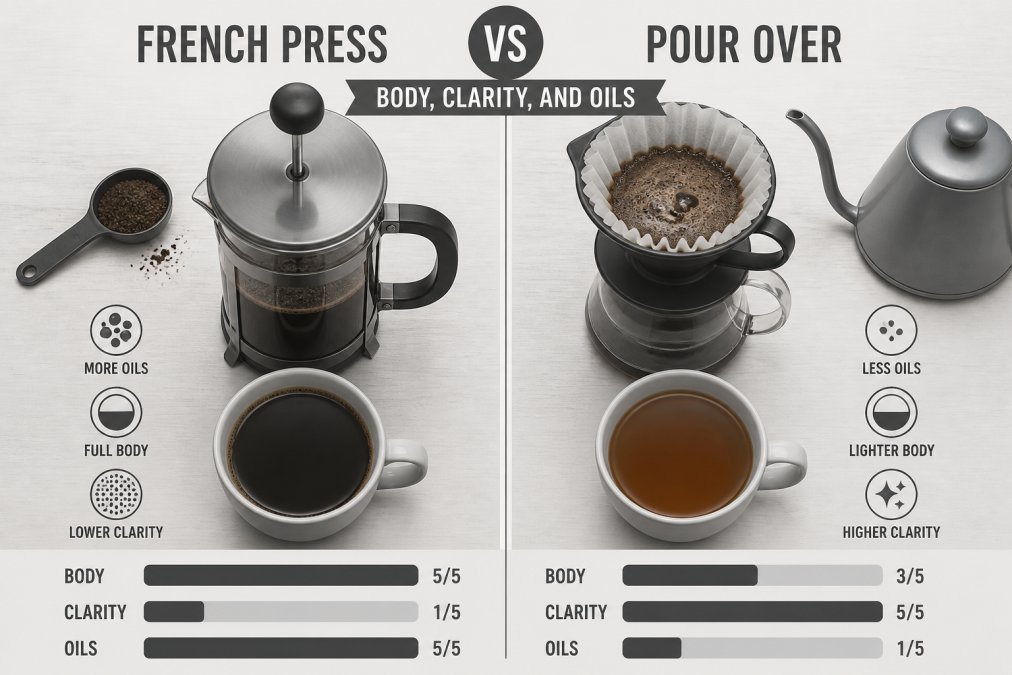
| Factor | French Press | Pour Over |
|---|---|---|
| Brew style | Immersion | Percolation |
| Filtration | Metal mesh | Paper filter |
| Body | Full-bodied, rich | Lighter, clean cup |
| Oils and sediment | Retained | Filtered out |
| Flavor clarity | Lower | Higher |
| Best for | Bold, heavy cups | Bright, precise cups |
The Role of Coffee Oils and Filtration
Coffee oils carry much of what we call richness. A metal mesh lets those oils and fine sediment through, so the French press delivers a heavier mouthfeel and a rounder finish. A paper filter catches them, producing a clean cup where acidity and brightness stand out instead of weight. If bold flavor means "thick and intense" to you, the press has the edge.
Pour Over Coffee Clarity vs Body: What You Actually Taste
Pour over coffee clarity vs body is the clearest way to understand the trade-off. Clarity means you taste distinct notes: citrus, berry, floral. Body means you taste weight and texture first.
The Best Coffee Grind Size for French Press (and Why Pour Over Differs)
Grind size is the single control that decides whether your bold flavor comes out rich or ruined, and most guides stop at "coarse for press, medium for pour over." That is not enough to dial in a cup. Here is the comparative guide most articles skip.
A Comparative Grind Guide for Bold Flavor
| Method | Grind target | Particle size (approx.) | Visual reference | Why it matters for bold flavor |
|---|---|---|---|---|
| French press | Coarse | 800-1,000 microns | Sea salt / raw sugar | Large particles slow extraction during the 4-minute steep so oils and heavy compounds release without pulling harsh bitterness |
| Pour over | Medium | 600-800 microns | Table salt / coarse sand | Moderate surface area extracts fully in 2.5-3 minutes, letting paper filtration sharpen what does come through |
Those micron ranges are working targets, not lab standards, most home burr grinders do not print a micron scale, so use them as a calibration goal and match the visual reference. A common pattern is that a grind sitting between the two (roughly 700-800 microns, finer than sea salt but coarser than table salt) under-extracts in a press and stalls a pour over, which is why the same bag can taste flat in one method and muddy in the other.
Why Particle Size Drives Bold Flavor
Extraction is a surface-area problem. Halve a coffee particle's diameter and you roughly quadruple the surface area water can reach. Finer grounds therefore extract faster and pull more solubles, including the tannins and bitter compounds that show up late in the curve. Coarse grounds expose less surface area per gram, so the same steep time yields a rounder, oilier cup instead of a sharp one.
Grind Consistency Matters More Than Grind Size
How to Brew Bold Coffee at Home: Ratios, Temperature, and Timing
Learning how to brew bold coffee at home comes down to three controls: brew ratio, water temperature, and time. Nail these and both methods deliver.
Switchyard Blend Medium-Dark Roast →
- Ratio: Start with 1:15 coffee to water. Use more coffee (1:12) for a heavier cup.
- Temperature: Aim for 195-205°F. Thermal stability keeps extraction even.
- Timing: French press steeps 4 minutes. Pour over finishes in 2.5-3 minutes.
- Bloom phase: Pour a little water first and wait 30 seconds to release trapped gas.
- Agitation: Stir the press gently; swirl the pour over to level the bed.
Water Chemistry, Temperature Stability, and Sustainability
Three angles most guides skip, and the ones that separate a good cup from a great one.
Water Chemistry: The Variable Nobody Measures
Water makes up roughly 98% of your brewed coffee, so its mineral content shapes extraction as much as your grind does. The two minerals that matter most are magnesium and calcium, plus the bicarbonate that buffers them.
- Magnesium binds readily to coffee's flavor compounds and pulls them into solution, which tends to amplify brightness and perceived intensity.
- Calcium contributes to body and can round out a heavy cup.
- Bicarbonate (alkalinity) neutralizes coffee's natural acids. Too much and the cup tastes flat and chalky; too little and it tastes sharp and hollow.
Temperature Stability: Thermal Mass and Dark Roasts
Brew temperature should sit between 195°F and 205°F, but the more important variable is how steadily a brewer holds that range. This is thermal mass, how much heat a vessel absorbs and retains.
Sustainability: Paper vs Metal Mesh
The paper filter is the sustainability sticking point. It is single-use, and most paper filters are not recyclable once saturated with coffee oils and fines. A metal mesh press filter is reusable for years with a rinse, which makes it the lower-waste option over time. If reducing daily trash matters to you, the press wins that round. According to guidance on reducing waste at home, reusing durable equipment instead of disposable items is one of the simplest ways to cut household waste.
Which Method Wins for Bold Flavor?
The French press wins for bold flavor if bold means heavy, oily, and rich. Pour over wins if bold means intense but clean, with every note in focus. There is no universal champion, only the cup you want.
Here is how to decide:
- Choose the French press for full body, natural oils, and a forgiving brew.
- Choose pour over for clarity, brightness, and precise control.
- Choose coarse for the press, medium for pour over.
- Choose fresh beans either way, because stale coffee tastes flat in both.
Frequently Asked Questions
Does French press or pour over taste better for bold coffee?
French press usually wins for bold flavor because the metal mesh filter lets coffee oils and fine sediment into the cup, adding body and richness. A paper-filtered pour over traps those oils, so the result is lighter but clearer. If bold means heavy mouthfeel and bittersweet chocolate notes, French press is the better fit. If bold means concentrated, clean flavor with high acidity, a pour over with a tight brew ratio can deliver that too.
Why does French press coffee have a bolder body than pour over?
The difference comes down to filtration. A French press uses a metal mesh that blocks large grounds but lets natural oils and fine particles through. Those oils coat your tongue and register as body. Paper filters in a pour over absorb most of those oils along with the sediment, so the cup tastes thinner and brighter. Neither is better, but if mouthfeel matters most, the metal mesh has the edge.
What grind size should I use for a French press?
Use a coarse grind, roughly the texture of sea salt. Coarse particles keep the metal mesh from clogging and prevent over-extraction during the four-minute steep. If your French press tastes muddy or bitter, your grind is probably too fine. If it tastes weak and watery, go slightly finer. A burr grinder gives you the grind consistency that a blade grinder cannot match.
Is French press or pour over better for a daily work routine?
It depends on how much time you have. A French press takes about four minutes of steeping with almost no attention, so it suits early mornings or short breaks. A pour over needs a steady hand and a slow spiral pour, usually three to four minutes of active work. For long shifts, the French press is easier to repeat without losing consistency.
The hardest part of brewing bold coffee is not the equipment. It is starting with beans fresh enough to reward either method. Mainline Roastery LLC roasts to order and ships the same day, so nothing sits in a warehouse losing flavor. Our Switchyard Blend brings a medium-dark roast with chocolate and praline notes, sold as whole bean so you can grind coarse for the press or medium for pour over. Get started with Mainline Roastery LLC and taste what fresh, bold coffee actually delivers.