

Table of Contents
- Why Roast Dates Beat Best-By Dates Every Time
- The Degassing Window: When Coffee Hits Peak Flavor
- How to Tell if Coffee Beans Are Fresh: A Sensory Checklist
- Best Time to Drink Coffee After Roast Date: Matching Roast Level to Freshness Window
- How to Store Coffee Beans for Maximum Freshness
- Troubleshooting Stale Beans: What to Do When Coffee Goes Flat
- Conclusion
- Frequently Asked Questions
Last Updated: September 29, 2026
Why Roast Dates Beat Best-By Dates Every Time
Coffee roast dates tell you when beans were roasted. Best-by dates tell you almost nothing useful. That's the short version.
A best-by date is a guess. It might sit a year out from packaging. It says nothing about when the beans peaked or how long they sat in a warehouse. A roast date is a fact. It's stamped by the roaster, and it starts the clock on everything that matters: flavor, aroma, and how the coffee behaves in your brewer.
At Mainline Roastery LLC, every bag is roasted to order and shipped the same day. That's the whole point of a roast date. It's a promise you can check.
So when you're learning how to evaluate coffee roast dates for freshness, start here: ignore the best-by stamp. Find the roast date. Then count the days.
The Degassing Window: When Coffee Hits Peak Flavor
Freshly roasted coffee releases carbon dioxide. This is called degassing, and it changes how your coffee brews. Understanding the mechanism is what separates a good cup from a frustrating one.
During roasting, heat drives off moisture and builds pressure inside the bean. That pressure traps carbon dioxide in the porous cell structure. After the roast ends, the bean keeps venting CO2 for days to weeks. While gas is still escaping, it physically blocks water from reaching the soluble compounds inside the grounds. Water can't soak in evenly, so extraction runs uneven: sour notes, weak body, and a cup that tastes thin and hollow.
Wait too long, and the opposite problem takes over. Once the bean stops pushing CO2 out, the same porous structure that vented gas starts pulling oxygen in. Oxygen oxidizes the oils on the bean surface, and those oils carry most of the aroma you paid for. The result is flat, papery, or cardboard-like flavor.
The sweet spot sits between those two failure modes.
Here's the practical version:
- Days 1-3 after roast: heavy degassing, best for espresso to rest
- Days 4-14: peak flavor for most brewing methods
- Days 15-30: still good, flavor starts to fade
- Past 30 days: drinkable, but you're losing aroma fast
Why the Window Isn't the Same for Every Bag
Two bags roasted on the same day can peak a week apart. A few variables drive that spread:
- Roast level. Darker roasts spend more time in the roaster at higher temperatures, which fractures the bean structure and drives off more gas. They degas fast and fade fast. Lighter roasts keep a denser structure, hold gas longer, and stay in their prime longer.
- Bean density. High-grown, hard beans (common in many Central American and East African lots) are denser and degas more slowly than softer, lower-grown beans.
- Process. Washed coffees tend to present a cleaner, more predictable curve. Natural and honey-processed coffees carry more surface compounds and can shift faster.
How to Tell if Coffee Beans Are Fresh: A Sensory Checklist
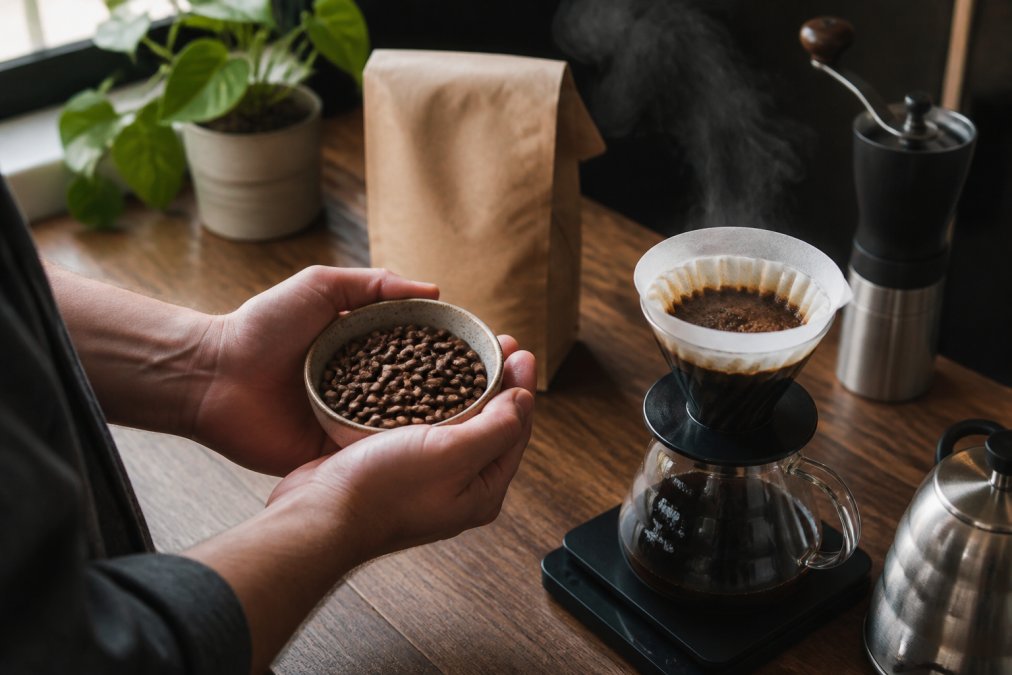
You don't need lab gear to judge freshness. Your eyes, nose, and a simple bloom test will tell you most of what you need to know.
Visual and Aromatic Tests
Start with your senses. These checks take under a minute.
- Look: Fresh beans have a slight sheen from surface oils. Dull, dry, faded beans are usually old.
- Smell: Open the bag. Fresh coffee hits you with a strong, sweet aroma. Stale beans smell flat or papery.
- Squeeze: Fresh beans are dense and hard. Old beans feel light and brittle.
- Check the seam: A dry, crumbly center line on the bean points to age.
The Bloom Test
The bloom is the puff of gas you see when hot water hits ground coffee. It's carbon dioxide escaping, and it's one of the clearest freshness signals you have.
Best Time to Drink Coffee After Roast Date: Matching Roast Level to Freshness Window
The best time to drink coffee after the roast date depends on the roast level. Darker roasts degas faster and fade sooner. Lighter roasts hold their flavor longer.
Switchyard Blend Medium-Dark Roast →
Here's how the freshness window shifts by roast:
| Roast Level | Rest Before Brewing | Peak Flavor Window | Starts Fading |
|---|---|---|---|
| Light | 5-7 days | Days 7-21 | Around day 21 |
| Medium | 3-5 days | Days 5-18 | Around day 18 |
| Medium-Dark | 2-4 days | Days 4-14 | Around day 14 |
| Dark | 1-3 days | Days 3-10 | Around day 10 |
How to Store Coffee Beans for Maximum Freshness
Storing coffee beans well comes down to blocking four things: oxygen, light, heat, and moisture. Get those under control and you protect the flavor profile for weeks. Miss one and the clock runs faster.
The rules are simple:
- Keep beans in an airtight container with a one-way valve if possible
- Store whole bean, not ground
- Keep the container in a cool, dark place
- Buy in small amounts so you finish before flavor fades
How a One-Way Valve Actually Works
A one-way valve is a small membrane built into the bag. It lets carbon dioxide escape from the inside without letting outside air in. That matters because a sealed bag of fresh beans would otherwise inflate and eventually rupture as CO2 builds. The valve solves both problems at once: it vents pressure while keeping oxygen out.
What to Avoid
A few common storage habits wreck freshness fast:
- The fridge: moisture and food odors get into the beans
- The freezer door: temperature swings every time you open it
- Clear jars in sunlight: light breaks down the oils
- The hopper: beans sitting in a grinder hopper go stale within days
Freezing Done Right
Freezing works, but only if you do it correctly. The goal is to stop the clock without introducing moisture or repeated temperature swings.
- Portion first. Divide beans into single-use amounts before freezing so you never thaw and refreeze the same batch.
- Seal tight. Use an airtight bag or vacuum-sealed portion. Squeeze out as much air as you can.
- Freeze cold and fast. A dedicated freezer that stays at a steady temperature beats a freezer door that swings every time it opens.
- Thaw fully before grinding. Let the portion come to room temperature sealed, so condensation forms on the bag, not the beans.
- Never refreeze. Each thaw cycle pulls moisture onto the bean surface and accelerates staling.
Troubleshooting Stale Beans: What to Do When Coffee Goes Flat
Stale coffee tastes dull, papery, or sour. Before you toss the bag, check whether the problem is the beans or your brewing variables.
Try these fixes first:
- Adjust your grind. Uneven extraction from a bad grind mimics staleness.
- Check your water temperature. Too cool, and you under-extract. Aim near boiling.
- Clean your equipment. Old oils in a dirty grinder ruin fresh beans.
- Run the bloom test. No bloom means the beans are done.
Conclusion
Judging coffee freshness comes down to reading the roast date, understanding the degassing window, and storing beans right. Do those three things and you'll taste the difference in every cup.
Frequently Asked Questions
How long after the roast date is coffee good?
Most coffee reaches peak flavor between 4 and 14 days after roasting, depending on roast level. Medium-dark roasts like Switchyard Blend tend to hit their stride around day 5 to 7 and stay strong for two to three weeks. After that, oxidation gradually dulls the flavor. Whole beans keep longer than pre-ground because less surface area is exposed to oxygen. For the boldest cup, aim to finish a 12 oz bag within three to four weeks of the roast date printed on the label.
What are the signs that coffee beans are past their prime?
Fresh beans smell sweet and complex; stale beans smell flat, papery, or like cardboard. Visually, fresh beans have a slight sheen from oils, while old beans look dry and matte. When you brew, stale beans produce a weak bloom with little bubbling, and the resulting cup tastes hollow or sour rather than rich. If your shot pulls fast with thin crema or your pour-over drains too quickly, the beans have likely lost their carbon dioxide and much of their flavor clarity.
Does coffee go bad after its roast date, or just lose flavor?
Coffee does not spoil in the food-safety sense after its roast date. It simply loses flavor. Oxidation and degassing strip away the volatile compounds that create aroma and complexity, so the coffee tastes flat rather than dangerous. A two-year-old bag will not make you sick, but it will taste like cardboard. For the best cup, treat the roast date as a freshness guide, not an expiration warning, and aim to brew within a few weeks of roasting.
How do you read a coffee roast date on different types of packaging?
Roast dates appear in several formats. Some bags print a clear 'Roasted On' date. Others use a Julian code (a three-digit number where 001 is January 1st). Some show only a best-by date, which is typically 9 to 12 months after roasting, so subtract accordingly. Look for roaster transparency: a brand confident in its freshness will print the roast date clearly, not hide it behind a best-by. One-way valve bags keep beans fresher longer by releasing carbon dioxide without letting oxygen in.
Fresh coffee shouldn't be a gamble. Mainline Roastery LLC roasts every bag to order and ships it the same day, so your beans arrive inside their peak flavor window. Choose from blends and single-origin options, order whole bean for maximum aroma, and taste what a real roast date delivers. Get started with Mainline Roastery LLC and brew bolder, fresher coffee from the first cup.