

Table of Contents
- Why Coffee Loses Flavor: The Four Enemies of Freshness
- What You'll Need to Store Coffee Properly
- Step-by-Step: How to Store Coffee to Keep Flavor
- How to Tell If Coffee Beans Are Fresh
- Best Coffee Storage Containers for Home Brewers
- Coffee Shelf Life After Roasting: What to Expect
- Common Storage Mistakes That Ruin Good Beans
- Travel Storage Solutions and Climate Considerations
- Frequently Asked Questions
Last Updated: September 13, 2026
Why Coffee Loses Flavor: The Four Enemies of Freshness
Roasted coffee begins losing quality the moment it leaves the roaster, and four forces drive that decline: air, light, heat, and moisture. Oxygen triggers oxidation, which strips the volatile oils responsible for aroma and flavor (Potential Aroma Chemical Fingerprint of Oxidised Coffee Note by HS-SPME-GC-MS and Machine...). Light accelerates that breakdown, heat speeds it up further, and moisture introduces both staleness and the risk of mold. The National Coffee Association has long pointed to proper storage as one of the most overlooked factors in home brewing quality, and it's an issue we think about constantly at Mainline Roastery LLC. Knowing how to store coffee to keep flavor intact comes down to controlling those four variables, and every decision below serves that single goal.
What You'll Need to Store Coffee Properly
An airtight, opaque container with a one-way valve is the single most important tool. Beyond that, you'll want whole beans rather than pre-ground coffee, a cool and dark storage location, and a way to label your roast date. If you plan to freeze coffee, add portion-sized bags and a permanent marker to the list. Nothing here is expensive, and most of it you already own.
Step-by-Step: How to Store Coffee to Keep Flavor
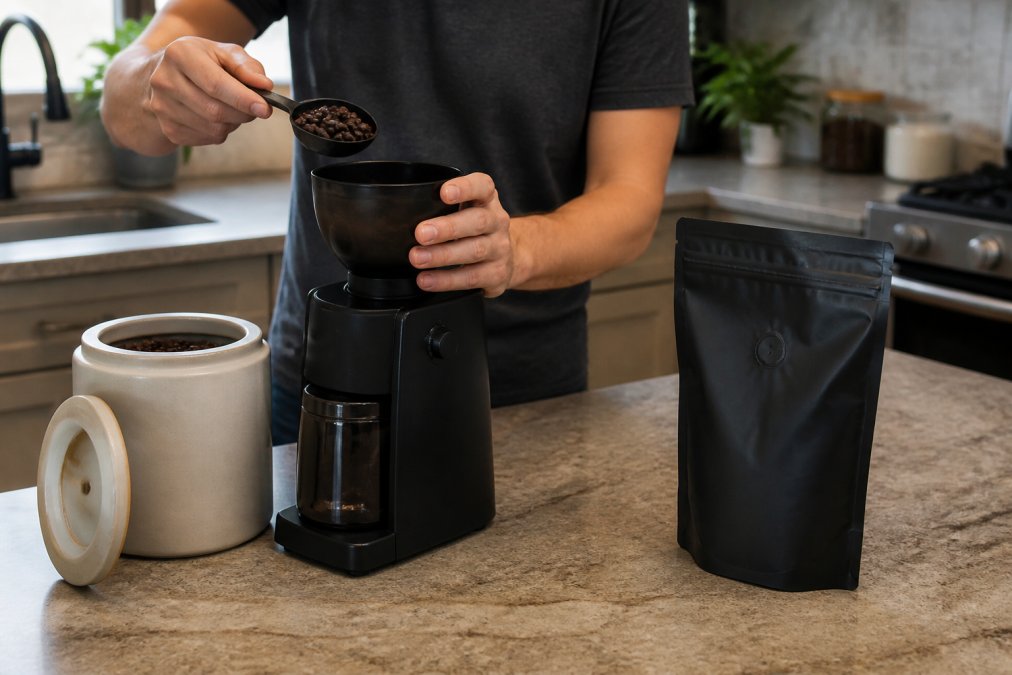
Step 1: Keep Beans Whole Until Brewing
Grinding exposes far more surface area to oxygen, so pre-ground coffee stales dramatically faster than whole bean. Grind immediately before brewing whenever you can. If your routine demands convenience, grind a single day's worth at most.
Step 2: Choose the Right Container and Location
Transfer beans to an airtight, opaque container and store it in a cool, dark cabinet away from the stove, oven, and windowsill. Clear glass canisters look great on a counter, but they let light through, which degrades the volatile oils. If you keep the original one-way valve bag, squeeze out excess air, seal it, and place it inside a second opaque container.
Step 3: Handle the Freezer the Right Way
Freezing works well for longer-term storage, but only if you do it correctly. Divide beans into portion-sized airtight bags, squeeze out the air, and freeze them. Take out what you need and let it come to room temperature before grinding. The mistake is repeatedly pulling a single container in and out: every trip back to room temperature introduces condensation, and that moisture ruins the beans.
How to Tell If Coffee Beans Are Fresh
Fresh beans smell sweet and complex when you open the bag, and they feel slightly oily or matte rather than dry and brittle. Stale beans smell flat or papery, and they produce a dull, lifeless cup no matter how you brew them. If your coffee tastes hollow or sour, freshness is usually the first suspect. This is why we print roast dates rather than vague "best by" labels: you deserve to know exactly what you're brewing.
Best Coffee Storage Containers for Home Brewers
Most guides stop at 'airtight and opaque.' That's the floor, not the ceiling. The material your container is made from interacts with roasted coffee in ways that matter over weeks, not hours, and the differences show up in the cup.
What the material actually does
Roasted coffee beans are porous and release carbon dioxide for days after roasting (the same gas that puffs up a valve bag) (pubmed.ncbi.nlm.nih.gov). They also absorb whatever volatile compounds are nearby. That two-way traffic is why container material matters:
- Stainless steel (304 or 18/8 food grade): Chemically inert, blocks 100% of light, and won't absorb or impart odors. The trade-off is that it's opaque, so you can't see how much is left, and a low-quality lid gasket, usually silicone or EPDM, is the weak point. Silicone gaskets can pick up coffee oils over time and need replacing every year or so.
- Opaque ceramic with a glazed interior: Also inert and light-blocking, and heavier, which means it sits still on the counter. The risk is unglazed or crazed glaze, which is porous and will hold onto stale oils. Check that the interior is fully glazed and free of cracks.
- Borosilicate or soda-lime glass: Chemically inert and easy to clean, but transparent unless coated. A clear glass canister on a counter exposes beans to the full visible spectrum, and light-driven oxidation of the oils is real. If you love glass, keep it inside a closed cabinet, not on display.
- Original one-way valve bag: The valve lets CO2 escape without letting oxygen in, which is why roasters ship in them. The foil-poly layer blocks light well. The weakness is the resealable zipper, which loses its grip after repeated openings and is not truly airtight once broken.
- Vacuum-sealed bags (nylon/polyethylene): Best oxygen barrier available at home, and they conform to the beans so there's almost no headspace. The catch is that every time you open one, you break the vacuum, so portion before sealing.
A practical comparison
| Container | Light block | Oxygen barrier | Odor transfer | Best for |
|---|---|---|---|---|
| Stainless steel, gasketed | Complete | Excellent | None | Daily pantry storage |
| Opaque glazed ceramic | Complete | Good | None | Countertop, short-term |
| Clear glass | None | Varies by lid | None | Inside a cabinet only |
| Original valve bag | Good | Good | Low | First 1-2 weeks post-roast |
| Vacuum-sealed bag | Complete | Excellent | None | Freezer, travel, long-term |
Sizing matters more than people think
A container that's too big leaves headspace full of oxygen that has to be displaced every time you open it. Match the container to roughly a week of beans. If you buy a 2-pound bag and store it in a 2-quart canister, you're re-exposing the whole batch every morning. Split it: keep a week's worth in the small canister and freeze the rest.
What to skip
- Clear plastic or acrylic canisters with a flip lid: Poor oxygen barrier, no light block, and the lid seal usually fails within months.
- Coffee vaults with a built-in CO2 release and no gasket: The valve is fine, but without a real seal the surrounding air still exchanges.
- Any container that held spices, onions, or garlic: Even washed, residual volatiles migrate into the beans.
Coffee Shelf Life After Roasting: What to Expect
Coffee shelf life after roasting is shorter than most people assume. Peak flavor typically falls within the first few weeks, and quality declines steadily after that. Whole beans hold up longer than pre-ground, and an unopened valve bag preserves freshness better than an open one. For the freezer, portioned beans can hold quality for several months. The practical rule: buy what you'll drink within a few weeks, and store the rest properly.
Common Storage Mistakes That Ruin Good Beans
The most common mistake is storing coffee in the fridge (Newsroom). Every time you open the door, temperature fluctuations cause condensation on the beans, and the fridge also transfers odors. Another frequent error is leaving beans in a clear container on a sunny counter. Buying pre-ground coffee and storing it for weeks is a third. Finally, don't buy more than you can drink in a reasonable window, no matter how good the deal looks.
Travel Storage Solutions and Climate Considerations
If you're packing coffee for a trip or a long shift, use a small vacuum-sealed bag or a travel-sized airtight container. Humidity is the enemy in damp climates, so add a desiccant packet if you're storing beans somewhere muggy. In dry, hot climates, keep beans away from direct sun and never leave them in a hot car.
Frequently Asked Questions
Will coffee stay fresh in a Ziploc bag?
A Ziploc bag is better than nothing, but it is not a real storage vessel for coffee. Standard plastic bags do not block oxygen or light, and they cannot hold a vacuum seal. Coffee beans release carbon dioxide and absorb moisture, so within a few days in a Ziploc, the volatile oils that carry aroma and flavor begin to degrade. If you must use one short-term, squeeze out as much air as possible and keep it in a dark, cool cabinet. For anything longer than a week, move to an opaque airtight container.
Should you store coffee beans in the freezer?
Yes, but only with the right technique. Freezer storage extends coffee shelf life after roasting from weeks to months, but the beans must be in an airtight, opaque container or a vacuum-sealed bag with the air removed. The biggest risk is temperature fluctuations and moisture. Take out only what you need for a few days, let the beans come to room temperature before grinding, and never refreeze thawed beans. Done correctly, frozen whole beans retain far more flavor than beans sitting in a warm pantry.
What is the best container to store coffee in?
An opaque, airtight container with a one-way valve is the best option for daily storage. Stainless steel and ceramic block light exposure, which protects volatile oils from UV degradation. Glass canisters work if they are dark-tinted or stored in a cabinet. Avoid clear plastic and any container that does not seal completely. For long-term storage, vacuum-sealed bags in the freezer outperform most countertop containers. Whichever you choose, keep it in a cool, dry place away from the stove and direct sunlight.
How long does coffee stay fresh after opening?
Whole bean coffee stays at peak flavor for about two to four weeks after the roast date if stored in an airtight container at room temperature. Pre-ground coffee degrades much faster, often losing noticeable aroma within seven to ten days because the increased surface area speeds oxidation. In the freezer, whole beans can hold good flavor for two to three months. After that, the coffee is safe to drink but the flavor profile flattens. Always check the roast date, not the best-by date, to judge freshness.
Great coffee deserves better than a stale shelf. At Mainline Roastery LLC, we roast fresh, ship fast, and print roast dates so you always know what you're brewing. Whether you're a home enthusiast or outfitting an office break room, our blends and single-origin beans deliver bold flavor from the first cup to the last. Get started with Mainline Roastery LLC and taste what fresh roasting actually means.