

Table of Contents
- What Makes Coffee 'Specialty' and Why It Matters at Home
- Choosing the Best Coffee for Home Brewing
- Essential Equipment for Brewing Specialty Coffee at Home
- Coffee Brewing Ratios: Getting the Golden Ratio Right
- How to Grind Coffee Beans for Your Brew Method
- Water Quality for Coffee Brewing: The Ingredient You're Ignoring
- Step-by-Step: How to Brew Specialty Coffee at Home
- Troubleshooting Common Brewing Mistakes
- Frequently Asked Questions
Last Updated: September 12, 2026
What Makes Coffee 'Specialty' and Why It Matters at Home
Specialty coffee scores 80 points or higher on the 100-point scale used by licensed graders, and that grade changes how you should brew it at home (sca.coffee). This guide from Mainline Roastery LLC covers what separates specialty beans from commodity coffee, and how to brew specialty coffee at home without wasting the quality you paid for.
Commodity coffee is grown for volume, roasted dark to mask defects, and built to survive months on a shelf. Specialty coffee is traceable to a farm or cooperative, picked at peak ripeness, and roasted to highlight the flavors already in the bean. A lightly roasted, high-scoring bean punishes bad brewing far more than a dark commodity roast, because uneven extraction shows up immediately in the cup.
Choosing the Best Coffee for Home Brewing
The best coffee for home brewing is freshly roasted specialty beans with a clear roast date, whole and unground, from a roaster who ships soon after roasting.
Freshness and Roast Dates
Buy coffee with a roast date, not a "best by" date, grocery shelves routinely hold beans roasted months earlier. Coffee degasses for the first several days after roasting, then loses aromatic compounds. Let beans rest a few days, then brew within two to four weeks for peak flavor (peer-reviewed research). Freeze what you won't finish in that window, in an airtight container, and grind from frozen.
Single-Origin vs. Blends
Single-origin coffees come from one farm, region, or cooperative and showcase a specific terroir: a washed Ethiopian might taste of jasmine and citrus, while a Brazilian natural leans chocolate and nut. Blends combine origins for balance and consistency. Want to taste what a specific farm did? Go single-origin. Want a dependable cup that holds up with milk? Go with a blend.
Mainline Roastery's Switchyard Blend is a medium-dark roast built from Caturra and Ethiopia Heirloom beans, roasted to order and shipped the same day.

Essential Equipment for Brewing Specialty Coffee at Home
You need four things: a brewer, a burr grinder, a digital scale, and a controllable kettle.
Brewers, Grinders, and Scales
| Equipment | What It Does | Why It Matters |
|---|---|---|
| Burr grinder | Crushes beans to a consistent size | Even particle size prevents channeling and bitterness |
| Digital scale | Weighs coffee and water in grams | Volume scoops vary wildly; weight does not |
| Gooseneck kettle | Controls pour speed and direction | Even saturation, better agitation control |
| Brewer | Holds the coffee and filter | Determines body, clarity, and brew time |
A common mistake is spending on a brewer and skimping on the grinder, the grinder affects extraction more. A blade grinder produces a mix of dust and boulders, the most common cause of a cup that tastes both bitter and sour at once.
Coffee Brewing Ratios: Getting the Golden Ratio Right
The golden ratio for brewing coffee is roughly 1:15 to 1:17, coffee to water by weight, 20 grams of coffee to 300-340 grams of water for a single mug. Too little coffee tastes weak and sour; too much turns bitter and muddy. Start at 1:16, then adjust: thin cup, tighten toward 1:15; heavy or harsh, loosen toward 1:17.
Common Ratios by Brew Method
| Method | Coffee-to-Water Ratio | Typical Brew Time |
|---|---|---|
| Pour over | 1:16 | 2:30-3:30 |
| French press | 1:15 | 4:00 steep |
| AeroPress | 1:13-1:15 | 1:30-2:30 |
| Drip machine | 1:16-1:17 | Per machine cycle |
| Moka pot | 1:10-1:12 | 3:00-5:00 |
How to Grind Coffee Beans for Your Brew Method
Grind size should match your brew time: the longer water touches coffee, the coarser the grind.
Why a Burr Grinder Matters
A burr grinder crushes beans between two rotating surfaces set to a fixed distance, producing uniform particles. Fine particles give up flavor fast, coarse ones slowly; when both exist in the same bed, water pushes through the fine ones first, channeling, and you get sour and bitter notes in the same sip. Burr grinders also adjust in repeatable steps, so a dialed-in setting is easy to return to.
Grind settings by method, as a starting point:
- Pour over: medium-fine, like table salt
- French press: coarse, like breadcrumbs
- AeroPress: medium-fine to fine
- Drip machine: medium
- Moka pot: fine, finer than drip but coarser than espresso
Water Quality for Coffee Brewing: The Ingredient You're Ignoring
Coffee is roughly 98% water by weight, so water chemistry sets the ceiling on how good your cup can get (peer-reviewed research). Two brewers using the same beans, grinder, and recipe can produce wildly different cups if their water differs, the variable almost every home guide skips.
The Specialty Coffee Association publishes a widely cited water standard for brewing. The key targets, expressed in parts per million (ppm), are:
| Component | Target Range | What It Does |
|---|---|---|
| Total hardness (as CaCO3) | ~50-175 ppm | Calcium and magnesium bind to coffee acids and pull flavor into the cup |
| Alkalinity (as CaCO3) | ~40-70 ppm | Bicarbonate buffers acidity; too much flattens the cup |
| pH | ~6.5-7.5 | Neutral range keeps extraction predictable |
| Sodium | Low | Contributes to perceived sweetness at low levels, saltiness at high |
| Chlorine / chloramine | Effectively zero | Masks aromatics; chloramine is harder to remove than chlorine |
Hard vs. Soft Water Impact
Hard water carries dissolved calcium and magnesium. Magnesium binds to the organic acids in roasted coffee and carries them into solution, which is why mineral-appropriate water tastes sweeter than stripped water. Too much hardness, though, turns the cup chalky, drying, and flat, and scales your kettle and brewer.
Soft or distilled water is the opposite failure: with no minerals to bind flavor compounds, extraction stalls and the cup tastes hollow and lifeless, no matter how good the beans are.
Reading Your Water
You do not need a lab. Two practical options:
- A TDS meter (a handheld pen, typically $15-30) measures total dissolved solids in ppm. Under ~50 ppm suggests under-mineralization; over ~250 ppm suggests over-mineralization.
- Your municipal water quality report (a Consumer Confidence Report) lists hardness, alkalinity, and disinfectant levels for your tap water.
If your tap water tastes like chlorine or leaves white scale in the kettle, it will do the same to your coffee. A simple carbon filter (pitcher or under-sink) removes chlorine and some organics but does not change hardness or alkalinity much.
Building Your Own Water
The most repeatable approach is to start with distilled or RO water and add a measured mineral concentrate, what many specialty cafes and competition brewers do, and the biggest upgrade a home brewer can make after the grinder. A common pattern is a two-part concentrate: one bottle of magnesium and calcium salts, one bottle of bicarbonate buffer, added to a gallon of distilled water in small doses. The goal is to land in the SCA ranges above and hold them constant so you can taste the coffee, not the water.
Never brew with straight distilled water. It has no minerals to carry flavor compounds out of the grounds, and the result tastes noticeably flat. If you use distilled water, add minerals first.
Change one water variable at a time. If you switch from tap to a mineral recipe, keep your grind, ratio, and temperature identical for a week so you can actually taste the difference water makes.
Step-by-Step: How to Brew Specialty Coffee at Home
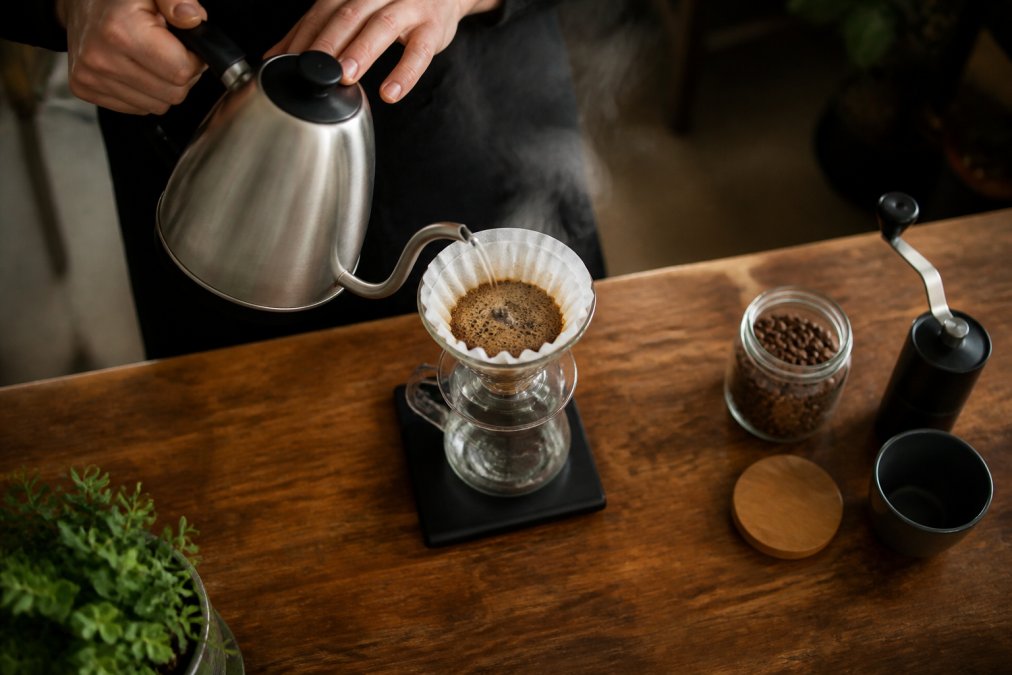
Here is the pour over method, which gives the most control and the clearest feedback on grind and ratio. Total time is about 8 minutes including boiling.
What you'll need: burr grinder, digital scale, gooseneck kettle, pour over dripper, filter paper, carafe or mug, 20 g coffee, 320 g water (a 1:16 ratio).
- Heat your water to 195-205°F. Just off a boil works. Boiling water scorches delicate light roasts.
- Weigh 20 g of beans and grind them medium-fine. Grind right before brewing; aroma fades within minutes of grinding.
- Rinse the filter with hot water. This removes paper taste and preheats the carafe. Discard the rinse water.
- Add the grounds and tare the scale to zero. Level the bed by shaking the dripper gently.
- Bloom with 60 g of water. Pour in circles from the center outward, wetting all grounds. Wait 30-45 seconds. The bed will swell and bubble as carbon dioxide escapes. If it does not swell, the coffee is likely stale.
- Pour the remaining 260 g in slow spirals. Aim for two or three pours, finishing between 2:30 and 3:30 total. Keep the water level steady and avoid pouring directly onto the filter paper.
- Let it drain fully, then remove the dripper. Swirl the carafe and serve.
Expected result: a flat, even coffee bed at the end, not a crater or a mud pit. An uneven bed tells you the pour or the grind needs adjustment.
Agitation: The Variable Most Guides Skip
Agitation, how much you stir, swirl, or pour, controls how quickly water moves through the coffee bed and how evenly it extracts. Too little and water channels through the same paths, leaving part of the bed under-extracted. Too much and fines migrate to the bottom, clog the filter, and stall the brew.
Three practical levers:
- The bloom stir. A gentle stir with a spoon or a quick swirl of the dripper right after the bloom breaks up clumps and ensures all grounds are wet. This is the single highest-value agitation step.
- Pour height and speed. Pouring from higher up increases turbulence; pouring slowly and close to the bed decreases it. A steady, moderate pour is the default; adjust from there.
- The final swirl. A gentle swirl of the dripper after the last pour settles the bed and helps it drain evenly.
Reading Your Brew: TDS and Extraction Yield
To move past "tastes sour" or "tastes bitter," measure extraction directly. Two numbers matter:
- TDS (total dissolved solids), the concentration of coffee solids in the finished cup, expressed as a percentage. A handheld refractometer measures this from a few drops of cooled coffee.
-
Extraction yield (EY), the percentage of the dry coffee grounds that ended up in the cup:
EY = (TDS × water weight) / coffee dose.
A common target for filter coffee is roughly 1.15-1.45% TDS and 18-22% extraction yield. Below that, the cup tastes under-extracted (sour, thin, salty); above it, over-extracted (bitter, dry, hollow).
You do not need a refractometer to brew well, but if you own one, it turns troubleshooting into arithmetic: a sour cup reading 16% EY tells you to grind finer or raise temperature, not to change three things at once.
French Press and Immersion Methods
Immersion brewing is more forgiving of technique, which makes it a good starting point. Use a coarse grind at 1:15, add all the water at once, stir gently, and steep four minutes. Press the plunger slowly, then decant immediately, leaving brewed coffee on the grounds turns the cup bitter within minutes.
If your pour over tastes inconsistent day to day, switch to immersion for a week. It removes pour technique as a variable and lets you isolate grind and ratio, which are the two things that actually matter most.
Troubleshooting Common Brewing Mistakes
Most bad cups trace back to four fixable problems. Work through them in order.
| Problem | Likely Cause | Fix |
|---|---|---|
| Sour, thin taste | Under-extraction | Grind finer or raise water temperature |
| Bitter, harsh taste | Over-extraction | Grind coarser or shorten brew time |
| Weak but bitter | Uneven grind | Switch to a burr grinder |
| Watery, flat cup | Wrong ratio or soft water | Tighten ratio, use mineral-balanced water |
A common mistake is changing two variables at once. Adjust grind, taste, then adjust again, a few brews to dial in a new bag is normal. Keep a brew log too: note the bean, roast date, grind setting, ratio, and how it tasted. After a month you will have a record of what actually works in your kitchen.
If you want beans fresh enough for this process to matter, Mainline Roastery roasts to order and ships the same day, with blends and single-origins delivered fast.
Frequently Asked Questions
What is the golden ratio for brewing specialty coffee?
The Specialty Coffee Association's Golden Ratio is 1:18, meaning one gram of coffee to 18 grams of water. For a standard 10-ounce mug, that's about 18 grams of coffee and 320 grams of water. This ratio produces a balanced cup that highlights sweetness and clarity. You can adjust to taste: use 1:15 for a stronger brew or 1:17 for a lighter cup. Always weigh your coffee and water with a digital scale for consistency, since volume measurements vary widely.
Does water temperature affect the taste of specialty coffee?
Water temperature directly controls extraction. The ideal range is 195-205°F (91-96°C). Water that's too hot scalds the grounds and pulls out harsh, bitter compounds. Water that's too cool under-extracts, leaving the coffee sour and weak. If you don't have a temperature-controlled kettle, boil water and let it rest for 30-60 seconds before pouring. For lighter roasts, aim closer to 205°F; for darker roasts, 195-200°F works better.
Why should I use a burr grinder for home brewing?
Burr grinders crush beans between two rotating burrs, producing uniform particles. Blade grinders chop inconsistently, creating a mix of fine dust and coarse chunks that extract at different rates. That unevenness causes both bitterness and sourness in the same cup. A burr grinder gives you consistent grind size, which is the single biggest upgrade you can make to your home setup. Even an entry-level burr grinder outperforms a blade grinder for specialty coffee.
How does bean freshness impact specialty coffee flavor?
Coffee peaks 4-14 days after roasting. During the first few days, beans release carbon dioxide (degassing), which can make brewing unpredictable. After two weeks, oxidation dulls the tasting notes and flatlines the acidity. Check the roast date on the bag, not the best-by date. Mainline Roastery roasts to order and ships the same day, so your beans arrive within days of roasting rather than sitting in a warehouse. Store beans in an airtight container away from light and heat.
The hard part of brewing at home is not technique, it is keeping fresh beans in the house. Stale coffee cannot be rescued by any ratio or grinder setting. Mainline Roastery roasts to order, ships the same day, and offers blends and single-origin beans with a bold flavor profile, plus wholesale options for offices and cafes. Get started with Mainline Roastery and brew a cup that actually tastes like what you paid for.