

Table of Contents
- Why Wholesale Coffee Beans Make Sense for Small Offices
- How to Calculate Office Coffee Consumption Before You Order
- Best Wholesale Coffee for Offices: What to Look For
- Wholesale Coffee Beans and Office Equipment Compatibility
- Bulk Coffee Bean Storage Tips to Maximize Freshness
- Sustainability and Sourcing Transparency in Wholesale Coffee
- Frequently Asked Questions
Last Updated: August 30, 2026
Why Wholesale Coffee Beans Make Sense for Small Offices
Switching to wholesale coffee beans for small offices is one of the most straightforward cost decisions an office manager can make. At Mainline Roastery LLC, we work with offices of all sizes, and the pattern is consistent: teams that move from retail bags to wholesale sourcing spend less per cup, drink better coffee, and stop running out mid-week.
The math is simple. Retail bags at a grocery store carry significant markup for packaging, shelf space, and distribution. Wholesale pricing cuts through that chain. You pay closer to what the coffee is actually worth, and you get it roasted fresher because specialty roasters ship directly rather than sitting on a distributor's shelf for months.

Cost Per Cup: Retail vs. Wholesale
The cost-per-cup difference between retail and wholesale is real, and it compounds fast. Retail bags are priced for convenience. Wholesale pricing is structured for volume, which means you get more coffee for the same budget. For a small office consuming several pounds per week, that difference adds up to meaningful savings over a quarter.
The calculation isn't just about the bean price either. Fresher coffee brews more efficiently. Stale coffee often needs a heavier dose to produce acceptable flavor, which quietly inflates your consumption. Buying fresher wholesale beans means you use less to get more flavor, which tightens your cost-per-cup further.
Freshness You Can Actually Taste
Freshness is where wholesale sourcing from a specialty roaster beats retail every time. Grocery store coffee can sit in a warehouse, then on a truck, then on a shelf for weeks or months before it reaches your breakroom. By then, the volatile compounds that create aroma and flavor have largely dissipated.
Wholesale coffee beans sourced from a roastery ship within days of roasting. The difference in the cup is not subtle. You get actual aroma, a cleaner flavor profile, and none of that flat, cardboard aftertaste that most office coffee is famous for. For a team that drinks coffee all day, that quality gap matters.
How to Calculate Office Coffee Consumption Before You Order
Ordering the right volume is where most offices get it wrong the first time. They either over-order and end up with stale beans, or they under-order and run out. Neither is acceptable.
Simple Formula for Monthly Bean Volume
Here is a reliable formula for how to calculate office coffee consumption:
Monthly bean volume = (Number of daily coffee drinkers) × (Cups per person per day) × (Grams per cup) × (Working days per month)
A standard specialty coffee brew uses roughly 15-18 grams of whole bean per 8-ounce cup. As a working example:
| Variable | Example Value |
|---|---|
| Daily coffee drinkers | 10 people |
| Cups per person per day | 2 cups |
| Grams per cup | 16 grams |
| Working days per month | 22 days |
| Monthly total | ~7 kg (15.4 lbs) |
Run this formula against your actual headcount before placing your first bulk order. Survey your team on average consumption if you're not sure. It takes five minutes and prevents a month of waste or shortage.
Subscription vs. One-Time Purchase: Which Fits Your Office
A coffee subscription delivers beans on a fixed schedule, which eliminates the risk of running out and removes the mental overhead of reordering. For offices with predictable headcount and consistent consumption, subscriptions are the better fit. You lock in a cadence, the beans arrive fresh, and the breakroom stays stocked.
One-time purchases make more sense for offices with variable attendance, seasonal fluctuations, or teams that work hybrid schedules. If your Friday headcount is half your Monday headcount, a rigid subscription can leave you sitting on more beans than you can brew fresh. The right answer depends on how predictable your office's coffee demand actually is.
Best Wholesale Coffee for Offices: What to Look For
Not all wholesale coffee is equal, and for office settings the selection criteria matter more than most buyers realize. You're choosing for a crowd with different preferences, different brewing equipment, and different tolerance for complexity.
Roast Profiles and Flavor Notes That Work for a Crowd
The biggest mistake with office coffee selection is going too niche. A very light roast with delicate floral notes is genuinely excellent coffee, but it will polarize an office. Some people love it. Others find it thin and sour compared to what they're used to.
Medium to medium-dark roast profiles are the practical sweet spot for shared office settings. They deliver enough body and richness to satisfy people who drink coffee for fuel, while still offering enough complexity to interest people who care about flavor. Look for flavor notes like chocolate, caramel, toasted nuts, or stone fruit. These read as approachable to a wide palate.
Mainline Roastery's Switchyard Blend is a strong example of this approach. It's a medium-dark roast built on Caturra and Ethiopia Heirloom beans from East Africa and South America, with notes of bittersweet chocolate and toasted marshmallow. That profile works for the person who wants bold coffee for a long shift and for the person who wants something more interesting than a generic dark roast. You can order the Switchyard Blend here.

Single Origin vs. House Blends for Office Settings
Single origin coffee is sourced from one specific farm, region, or cooperative. It showcases the distinct characteristics of that growing environment, which can mean pronounced acidity, unusual fruit notes, or a very specific flavor profile.
House blends combine beans from multiple origins to create a consistent, balanced cup that holds up across different brewing methods and tastes.
For office settings, blends generally win. They're more forgiving of minor brewing inconsistencies, they appeal to a broader range of palates, and they deliver a consistent experience batch after batch. Single origins are excellent for offices with a genuinely coffee-focused culture, or as a rotating "feature" alongside a reliable house blend.
Organic and Fair Trade Certifications: What They Mean
Certifications matter to many buyers, and it's worth understanding what they actually certify. According to the USDA National Organic Program standards, organic certification means the coffee was grown without synthetic pesticides or fertilizers, and the supply chain has been audited to verify that claim.
Fair Trade certification, governed by organizations like Fair Trade USA, focuses on the economic side: minimum price floors for farmers, community development premiums, and labor standards. Direct trade is a related but different model where roasters build relationships directly with farms, often achieving higher transparency than certification alone provides.
For office buyers, certifications are a reasonable proxy for ethical sourcing when you can't audit the supply chain yourself. They add cost, but they also add accountability.
Wholesale Coffee Beans and Office Equipment Compatibility
Buying excellent wholesale coffee beans and then grinding them wrong, or brewing them incorrectly, is a surprisingly common problem. The beans are only part of the equation.
Grind Size and Brewing Equipment Basics
Grind size must match your brewing method. This is not optional. The wrong grind size produces either under-extracted (sour, thin) or over-extracted (bitter, harsh) coffee regardless of how good the beans are.
- Drip coffee makers: Medium grind, similar in texture to coarse sand
- Commercial batch brewers: Medium to medium-coarse, adjusted for flow rate
- Espresso machines: Fine grind, consistent and uniform
- French press or cold brew: Coarse grind
Most offices run drip or commercial batch brewers. If you're ordering whole bean coffee, you need a grinder capable of consistent output at medium grind settings. Burr grinders outperform blade grinders significantly for consistency. A blade grinder produces uneven particle sizes that brew unevenly, which is one of the fastest ways to waste good coffee.
Brewing Ratios for Large Batches
Brewing ratios for large batches is an area where offices almost universally under-dose. The standard specialty coffee ratio is roughly 1:15 to 1:17 by weight (coffee to water). For a 60-ounce commercial batch brewer, that means approximately 100-115 grams of ground coffee.
Most offices are using far less than this, which is why office coffee often tastes weak and flat. It's not the beans. It's the dose.
A simple reference table for common batch sizes:
| Batch Size | Coffee Dose (1:16 ratio) |
|---|---|
| 12 oz (1 cup) | 21 grams |
| 32 oz (small carafe) | 57 grams |
| 64 oz (large carafe) | 114 grams |
| 96 oz (commercial batch) | 170 grams |
Weigh your doses until you have a feel for it. Volume measurements with scoops vary too much to be reliable.
Equipment Maintenance to Protect Coffee Quality
The thing nobody tells you about office coffee equipment is how fast mineral buildup degrades cup quality. Hard water deposits accumulate in heating elements, brew heads, and carafes, and they affect both temperature stability and flavor.
Descale commercial brewers monthly if your water is hard, quarterly at minimum otherwise. The NSF International commercial coffee equipment standards provide guidance on sanitation intervals that most food service operations follow. Wipe brew baskets and carafes after every use. Replace carafe seals annually. These steps cost almost nothing and preserve the quality of every batch you brew.
Bulk Coffee Bean Storage Tips to Maximize Freshness
Proper storage is the bridge between a great wholesale purchase and a great cup. Bulk coffee bean storage tips often get ignored, but bad storage can erase the freshness advantage of buying directly from a roastery.
Whole beans have four enemies: oxygen, moisture, heat, and light. Address all four and your beans will stay fresh for three to four weeks after roasting.
- Store beans in an airtight container, not the original bag (unless the bag has a one-way valve and resealable closure)
- Keep containers away from direct sunlight and heat sources like ovens or coffee makers
- Room temperature storage is fine for beans you'll use within two to three weeks
- Freeze only what you won't use within a month, in sealed, portioned bags, thaw fully before opening to prevent condensation
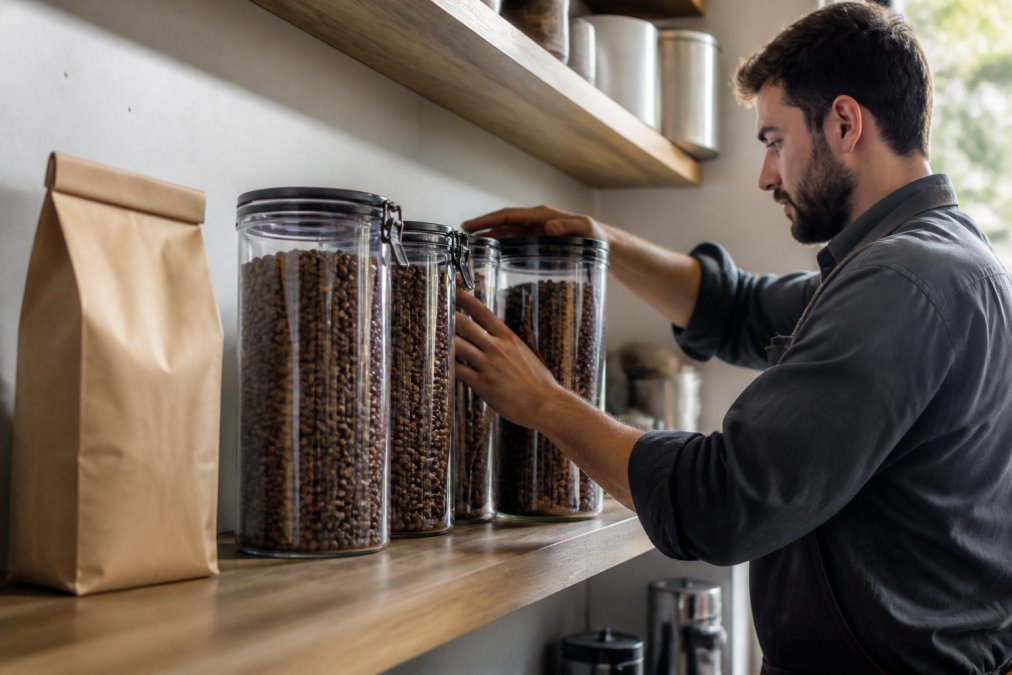
The freezer debate is real, but the practical answer for offices is simple: if you're ordering the right volume and consuming it within three weeks, you don't need to freeze anything. Calibrate your order frequency so beans are always fresh, not stockpiled.
Sustainability and Sourcing Transparency in Wholesale Coffee
Sustainability in wholesale coffee has moved from a marketing angle to a genuine sourcing criterion for many offices. Employees notice, and increasingly, corporate purchasing policies require it.
The most credible sourcing transparency comes from roasters who can name the farm or cooperative, describe the processing method, and explain the relationship. Certifications like USDA Organic and Fair Trade USA provide a floor of accountability, but direct trade relationships often go further, with roasters publishing crop data, visit records, and pricing transparency.
According to Specialty Coffee Association resources on supply chain transparency, the specialty coffee sector defines quality in ways that inherently favor ethical sourcing: the farms producing the best-scoring arabica beans are generally those investing in careful processing, worker welfare, and sustainable land management. Quality and ethics are more aligned in specialty coffee than in commodity coffee.
For offices that want to report on sustainability, ask your wholesale supplier for origin documentation, certification copies, and any available impact data. A roaster who sources responsibly will have this information readily available. One who can't provide it probably can't verify their claims.
The broader environmental picture matters too. Batch roasting in smaller, more frequent cycles, as specialty roasters typically do, produces fresher coffee and reduces waste from unsold inventory sitting in distribution chains. That's a supply chain efficiency argument and an environmental one simultaneously.
Most offices are drinking coffee that's older, weaker, and more expensive per cup than it needs to be. Mainline Roastery LLC was built to fix exactly that problem, with freshly roasted specialty blends and single-origin beans shipped directly so your breakroom gets the same quality as any serious coffee program. The Switchyard Blend is our starting recommendation for offices: a medium-dark roast with the body and flavor to hold up across a full workday and a full team. Get started with Mainline Roastery LLC and put genuinely good coffee in your breakroom.
Frequently Asked Questions
How much coffee does a small office typically consume per month?
A common estimate is roughly 1.5 to 2 cups per employee per workday. For a 10-person office with 22 workdays, that works out to 330 to 440 cups monthly. At a standard brewing ratio of about 1 gram of whole bean coffee per 15 milliliters of water, a 5-pound bag covers roughly 90 to 100 cups. Most small offices in that size range go through 4 to 5 bags per month, making wholesale coffee beans a practical and cost-effective choice.
Is it more cost-effective to buy wholesale coffee beans versus retail?
Yes, for offices that brew consistently. Retail grocery coffee often costs more per ounce and is rarely freshly roasted. Wholesale coffee beans from a specialty roastery like Mainline Roastery give you a lower cost per cup alongside noticeably better flavor. The Switchyard Blend, for example, is priced at $17.99 and delivers a medium-dark roast with genuine complexity. When you factor in employee satisfaction and reduced waste from stale coffee, the value is clear.
What is the difference between single-origin and blended wholesale coffee for offices?
Single-origin beans come from one farm or region and carry distinct flavor notes tied to that origin, such as bright acidity or fruity aroma. Blends combine beans from multiple origins to create a consistent, balanced cup that holds up across different brewing equipment and palates. For most offices serving a mixed group, a well-crafted house blend is the safer starting point. Single-origin options work well when your team has more specific preferences or you want to rotate for variety.
How do you keep bulk coffee beans fresh when ordering for an office?
Store whole beans in airtight, opaque containers away from heat, light, and moisture. Avoid the freezer for beans you plan to use within two to three weeks, repeated temperature changes accelerate staling. Order in quantities you can consume within 30 days of the roast date, and check that your supplier ships shortly after roasting. Buying wholesale coffee beans from a roastery that roasts to order, rather than sitting on pre-roasted inventory, is the single most effective way to protect freshness.
What equipment does a small office need to brew wholesale whole bean coffee?
At minimum, you need a commercial-grade burr grinder and a brewer sized for your team. A batch brewer that produces 64 to 96 ounces per cycle works well for offices of 10 to 20 people. Burr grinders produce a consistent grind size, which directly affects extraction and flavor. Avoid blade grinders, they produce uneven particles that make espresso beans taste bitter and light roast coffee taste thin. Clean the grinder weekly and descale the brewer monthly to maintain cup quality.
What should a small office look for in a wholesale coffee supplier?
Prioritize roast-to-order freshness, transparent sourcing, and reliable shipping timelines. A supplier should be able to tell you where the arabica beans come from, when they were roasted, and how long delivery typically takes. Fair trade and organic certification add accountability to ethical sourcing claims. Consistent wholesale pricing and the option to set up a recurring order matter as much as the coffee itself, you want a supplier who treats small offices as real wholesale accounts, not just retail customers.
This article was written using GrandRanker