

Table of Contents
- 1. Why Locally Roasted Coffee Beats Stale Grocery Store Beans
- 2. The Benefits of Freshly Roasted Coffee for Your Break Room
- 3. How to Choose a Coffee Roaster for Your Office
- 4. Office Coffee Cost Per Employee: The Real Numbers
- 5. What a Local Coffee Roaster Wholesale Program Looks Like
- 6. Employee Satisfaction and Workplace Experience Gains
- 7. Sustainability and Supply-Chain Transparency
- Conclusion: Making the Switch to Locally Roasted Coffee
- Frequently Asked Questions
Last Updated: October 12, 2026
1. Why Locally Roasted Coffee Beats Stale Grocery Store Beans
The biggest benefits of switching to locally roasted office coffee come down to time.
That gap shows up in the cup. A "best by" date tells you when coffee expires, not when it was roasted; a local roaster prints an actual roast date.
We built Mainline Roastery around that principle: every bag is roasted to order and shipped the same day, so your break room gets coffee at its peak.
The Freshness Gap: Roast Date vs. Best-By Date
A roast date is the day the coffee was roasted; a best-by date is a manufacturer's estimate of how long a sealed bag stays acceptable.
- Roast date: printed by specialty roasters, usually within days of shipping
- Best-by date: often 6 to 12 months out, with no roasting information at all
- Oxygen, light, and heat degrade coffee oils over time
A common mistake is buying a bulk bag to save money, then watching the last third go flat. Freshness beats volume.
2. The Benefits of Freshly Roasted Coffee for Your Break Room
Freshly roasted coffee delivers more aroma, more flavor, and a noticeably better cup than coffee that has sat for months, the short version of the benefits of freshly roasted coffee.
Flavor, Aroma, and Why Your Team Will Notice Immediately
The moment you open a fresh bag, the aroma hits you. That fragrance comes from volatile compounds that fade fast after roasting. Grocery store coffee has usually lost most of them.
What to expect from fresh beans:
- Aroma that fills the room when you grind
- Fuller body and clearer flavor notes
- Natural sweetness instead of a flat, papery taste
Roast level matters too. A medium roast balances sweetness and body, a medium-dark roast brings out chocolate and caramel notes, and lighter roasts highlight brighter, fruitier flavors. Matching the roast profile to your team's taste raises satisfaction fast.

3. How to Choose a Coffee Roaster for Your Office
Choosing a roaster comes down to five questions: how fresh is the coffee, what does it cost per cup, can they handle your volume, how transparent is their sourcing, and how fast do they deliver. Most offices treat this like a retail purchase when it is really a small procurement decision with delivery, inventory, and equipment implications.
The Five Questions, Answered Concretely
1. How fresh is the coffee, and can they prove it? Ask for a roast date printed on the bag, not a best-by date.
2. What is the true cost per cup? Compare cost per brewed cup, not bag prices.
**3.
4. How transparent is their sourcing? A roaster should name the regions, and ideally the farms or cooperatives, behind each blend.
5. How reliable is delivery? Offices underweight this.
A Practical Evaluation Checklist
Use this before you commit to a supplier:
- Do they print a roast date on every bag?
- Do they roast to order or pull from warehouse stock?
- Can they supply consistent wholesale volume for your office size?
Match the Coffee to Your Brewer, Not the Other Way Around
Before you sign anything, confirm the roaster can supply coffee that works with your existing equipment. Most office brewers fall into a few categories, batch drip, single-serve pod, and espresso, each with different grind and format requirements. A roaster offering whole bean, drip-ground, and pod formats gives you flexibility if you change brewers later; one who only sells whole bean forces you to add a grinder.
A local roaster usually wins on freshness, sourcing transparency, and delivery reliability. National brands often cannot answer the roast-date or origin questions directly. That gap is the whole reason to switch.
4. Office Coffee Cost Per Employee: The Real Numbers
Office coffee cost per employee depends on how much your team drinks, not the sticker price of the bag. The per-cup math is what matters, and most offices never run it. Here is the calculation end to end.
Step 1: Convert Bags to Cups
A 12 oz bag of whole bean coffee brews roughly 25 to 30 cups, depending on grind, brew ratio, and strength; a 5 lb bulk bag brews roughly 170 to 200 cups. Use the low end for a conservative estimate.
Step 2: Estimate Daily Consumption
A common planning assumption is 2 to 3 cups per coffee drinker per workday, multiplied by the number of drinkers and roughly 21 workdays per month.
Example: 20 employees, 10 of whom drink coffee, at 2.5 cups per day each.
- 10 drinkers × 2.5 cups = 25 cups per day
- 25 cups × 21 workdays = 525 cups per month
- 525 cups ÷ 27 cups per 12 oz bag ≈ 19 to 20 bags per month
That is your baseline volume. Everything else, pricing, delivery, waste, is measured against it.
Switchyard Blend Medium-Dark Roast Coffee 12 oz →
Step 3: Calculate Cost Per Cup
| Factor | What to Track | Why It Matters |
|---|---|---|
| Bag price | Cost per 12 oz bag | Sets your starting cost |
| Cups per bag | Roughly 25-30 cups per 12 oz | Converts bags to servings |
| Daily consumption | Cups per person per day | Drives total volume |
| Waste | Coffee poured out, not drunk | Quietly inflates cost |
| Delivery | Shipping or pickup cost | Affects true per-cup price |
| Equipment | Brewer, grinder, filters, cleaning | Often overlooked in comparisons |
Divide the bag price by the cups-per-bag range for your real per-cup cost, multiply by monthly consumption for monthly spend, then divide by the number of coffee drinkers for cost per employee per month.
Step 4: Add the Costs Offices Forget
Three costs routinely get left out of office coffee comparisons:
Waste. Stale coffee gets poured out. If a third of every bulk bag goes flat before brewing, your effective cost per cup is roughly 50 percent higher than the sticker math suggests. Fresh coffee gets finished, which is why a pricier fresh bag can beat a cheaper bulk bag on true cost per cup.
Delivery and minimums. Some suppliers charge shipping below a threshold, or require a minimum order that forces you to buy more than you can drink before it stales. Both inflate the real per-cup price.
Equipment. Switching to whole bean may require a grinder; switching formats may require a different brewer. Factor those one-time costs into your first-year comparison, not just the recurring bag price.
Step 5: Compare the Two Arrangements Side by Side
Run the same five-step calculation for your current supplier and a locally roasted alternative. What matters is cost per cup, adjusted for waste, delivery, and equipment, divided by the number of employees who actually drink the coffee. In most offices, the freshness advantage closes the price gap and waste reduction pushes the local option ahead.
Track These Numbers After You Switch
Once you have switched, keep measuring. The same inputs that drove the decision become the evidence it was right:
- Bags ordered per month versus bags consumed per month
- Cups brewed per day, tracked by a simple tally or brewer counter
- Coffee poured out versus coffee drunk
A common pattern: waste drops in the first month, consumption holds steady or rises slightly, and cost per cup falls once bulk buying is replaced with a right-sized standing order. Those are the numbers to bring to whoever approves the coffee budget.
5. What a Local Coffee Roaster Wholesale Program Looks Like
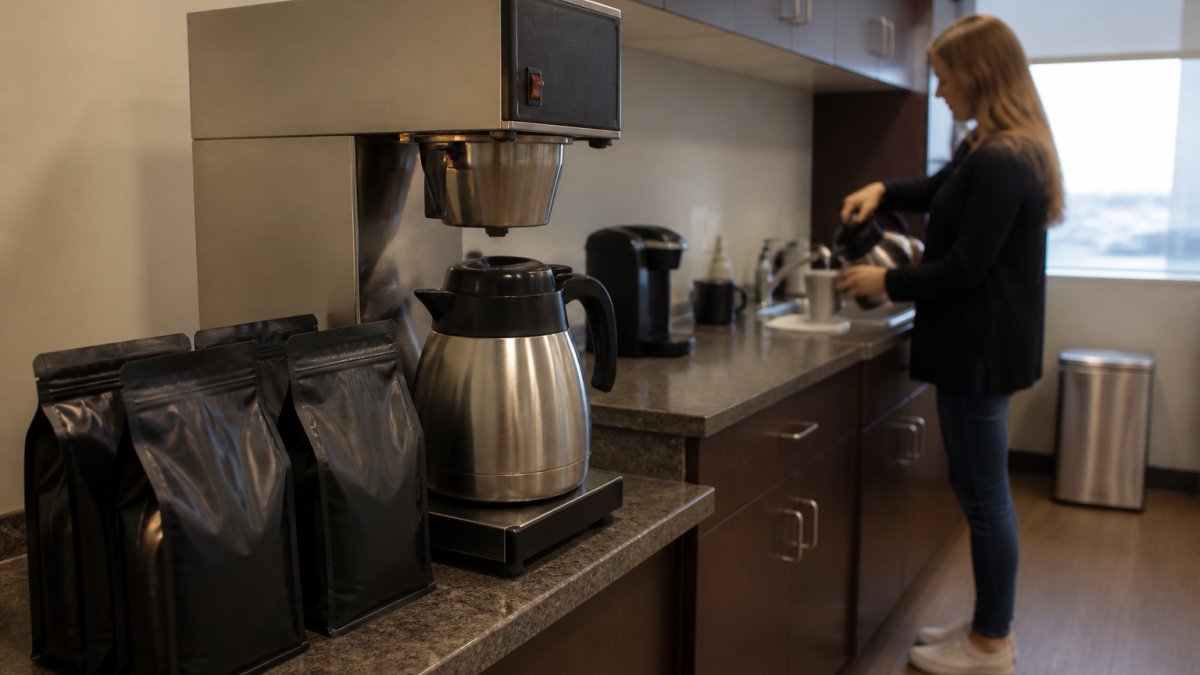
A local coffee roaster wholesale program is a recurring supply arrangement where a roaster delivers freshly roasted beans to your office on a set schedule, usually at a lower per-unit price than retail.
6. Employee Satisfaction and Workplace Experience Gains
Better break room coffee is one of the cheapest workplace experience upgrades available: it touches every employee, every day, for far less than most perks.
Think about what your break room signals. A stale pot says the small things do not matter; a fresh, good cup says the opposite.
What improves when the coffee improves:
- Fewer coffee runs that pull people out of the office
- A break room people actually use and linger in
- A simple, visible sign that leadership pays attention
For teams on long or irregular shifts, this matters more: coffee that holds its flavor through a full day keeps people going without a mid-shift slump.
7. Sustainability and Supply-Chain Transparency
Sustainability in coffee comes down to two things: how the green coffee beans are grown and sourced, and how much waste your office generates.
Ask any roaster these questions:
- Which regions do your beans come from?
- Which farms or cooperatives do you buy from?
- What processing methods do you use, washed or natural?
Transparency is a good sign: a roaster who can name regions and processing methods knows their supply chain.
Sustainability also means less waste in your break room. Fresh coffee gets drunk; stale coffee gets dumped. Buying what your team will actually finish is the simplest environmental win available.
Conclusion: Making the Switch to Locally Roasted Coffee
Switching suppliers feels like a hassle, and that hesitation keeps offices stuck with stale coffee. The transition is simpler than it looks: pick a roaster, set a standing order, and let the delivery schedule do the rest.
At Mainline Roastery LLC, we roast to order and ship the same day, so your break room never sits on old beans. Our lineup covers blends and single-origin coffee, and our wholesale program is built for offices that need reliable, repeat deliveries.
Frequently Asked Questions
What are the benefits of locally roasted coffee for an office?
Locally roasted coffee arrives days after roasting instead of months, so your team gets fuller flavor, better aroma, and fresher coffee oils. Offices also gain faster delivery, lower per-cup costs through bulk ordering, and a supplier who can customize roast profiles to your team's taste preferences. The benefits of freshly roasted coffee extend to employee satisfaction, since a quality break room experience signals that leadership values the workplace environment.
How much does office coffee cost per employee?
Cost per employee depends on daily consumption and the coffee you buy. A 12 oz bag of whole bean coffee brews roughly 20 to 24 cups at a 1:15 coffee-to-water ratio. If your team drinks two cups per day, one employee uses about two bags per month. Multiply your bag price by that figure to get an accurate office coffee cost per employee, then compare it against what you currently spend on mass-produced coffee and waste.
How do I choose a local coffee roaster for my office?
Start by asking three questions: When was the coffee roasted? How fast is delivery? Do you offer a wholesale program? A roaster who prints a roast date on every bag and ships within days is a better sign than one who only lists a best-by date. Also ask about roast profiles, whether they offer whole beans and ground coffee, and whether they can handle recurring office orders without gaps in supply.
Is locally roasted coffee worth the cost for an office?
The price premium per bag is usually offset by less waste, better flavor retention, and higher employee satisfaction. Stale coffee gets dumped; fresh coffee gets finished. When you factor in bulk ordering through a wholesale program, the per-cup cost often lands close to what you already pay for commercial coffee, while the coffee experience improves noticeably. Many offices find the switch pays for itself in reduced waste alone.