

Table of Contents
- What Actually Matters in a Small Office Coffee Setup
- Best Coffee Maker for a Small Office: Batch Brewers and Pod Machines
- French Press for Office Kitchens: Cheap, Quiet, and Slow
- Pour-Over Coffee for the Office: Control Without the Counter Hogging
- Espresso, AeroPress, Moka Pot, and Cold Brew: The Niche Options
- Total Cost of Ownership: What Each Method Really Costs Per Cup
- Noise, Counter Space, Hygiene, and Accessibility at a Shared Station
- A Decision Matrix for Small Offices
- Frequently Asked Questions
Last Updated: October 8, 2026
What Actually Matters in a Small Office Coffee Setup
The best coffee brewing methods for small offices are the ones your team will actually use daily, not the ones that look impressive on a spec sheet.
A brewer that takes four minutes per cup and needs rinsing between uses sits idle by week three; one that fills eight cups in six minutes and wipes clean in thirty seconds becomes the center of the break room.
Below, we break down every major method against those five criteria, with a decision matrix for whoever controls the budget.
The Five Criteria That Decide It
Batch capacity is how many cups you can pour back-to-back before anyone waits. Footprint is counter space, including clearance for the lid and carafe. Noise matters more than people admit in open-plan offices. Cleanup determines hygiene. Cost per cup is the number that survives budget season.
| Criterion | Why It Decides the Purchase |
|---|---|
| Batch capacity | Prevents the 9 a.m. queue |
| Counter footprint | Small kitchens have fixed space |
| Noise level | Grinders and pumps carry in open offices |
| Cleanup effort | Shared stations get neglected fast |
| Cost per cup | Justifies the spend to finance |
Best Coffee Maker for a Small Office: Batch Brewers and Pod Machines
The best coffee maker for a small office is a batch drip brewer for teams of five or more, and a single-serve pod system for teams of two to four. Batch brewing wins on cost per cup and throughput; pods win on convenience.
Drip Coffee Makers and Batch Brewing
A drip brewer heats water, passes it through ground coffee in a paper or reusable filter, and holds the finished pot on a warming plate or in a thermal carafe.
For a ten-person team, one brew cycle covers the morning rush. Choose a thermal carafe over a glass pot if the station sits empty between rushes, because coffee on a hot plate turns bitter within twenty minutes.
Use a medium grind and a 1:15 coffee-to-water ratio as your baseline, then adjust.
Single-Serve Coffee Systems
Single-serve machines brew one cup from a sealed pod or refillable capsule: no pot to burn, no filter to change, no learning curve. Pods cost more per cup than bulk ground coffee and the waste adds up; refillable capsules split the difference by letting you use your own freshly ground beans. Best for offices where people arrive at different times and nobody wants coffee duty.
French Press for Office Kitchens: Cheap, Quiet, and Slow
A French press, also called a cafetière, steeps coarse ground coffee in hot water for about four minutes, then separates the grounds with a metal plunger. It's the quietest and cheapest method here.
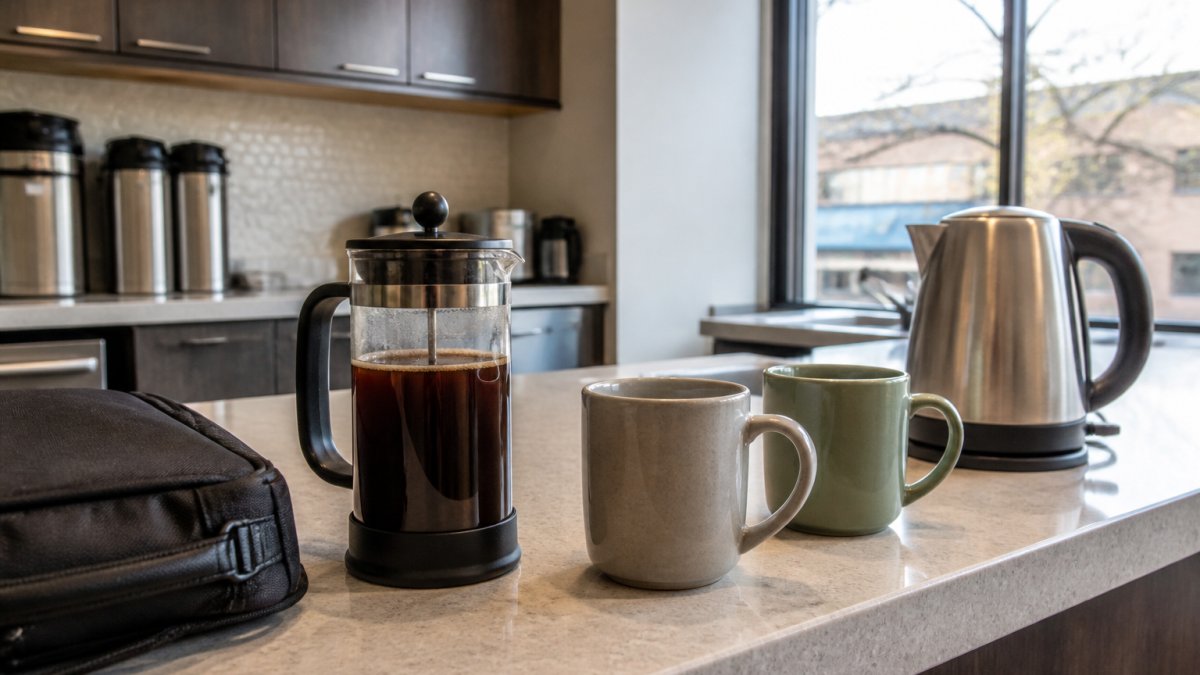
The catch is throughput: one press makes two to three cups, each needing a full four-minute steep. Fine for three people; a bottleneck for twelve.
Pour-Over Coffee for the Office: Control Without the Counter Hogging
Pour-over coffee for the office delivers the cleanest cup and the most control, but it demands attention. You heat water, wet a paper filter, add medium-fine grounds, and pour in slow circles over two to three minutes. Equipment is minimal, a cone dripper, filters, and a kettle; a gooseneck spout helps, though a standard electric kettle works if you pour carefully.
Espresso, AeroPress, Moka Pot, and Cold Brew: The Niche Options
Espresso machines, AeroPress, Moka pots, and cold brew are specialty tools. Each produces an excellent cup, and each asks for more time, space, or planning than a batch brewer.
Espresso and Semi-Automatic Machines
A semi-automatic espresso machine gives you control over grind, dose, and shot time, but it needs a quality burr grinder, regular backflushing, and someone willing to learn the workflow. Without a genuine espresso drinker to own it, it becomes an expensive decoration; with one, it becomes the best perk in the building.
AeroPress and Other Manual Brewers
The AeroPress is a compact manual brewer that makes one concentrated cup in about ninety seconds; it's quiet, nearly indestructible, and easy to rinse. A Moka pot works on a stovetop and produces a strong, espresso-like brew, but it needs a burner, ruling out most office kitchens. Both are great personal brewers; neither scales to a team.
Cold Brew for Warm Afternoons
Cold brew steeps coarse ground coffee in room temperature water for twelve to eighteen hours, then gets strained and refrigerated. It's smooth, low-acid, and perfect for summer, but the catch is planning: you're brewing today for tomorrow. A large jar or dedicated cold brew maker handles a week's worth in one batch, making it surprisingly efficient for offices wanting an iced option without a second machine.
Total Cost of Ownership: What Each Method Really Costs Per Cup
Cost per cup is where batch brewing separates itself from everything else, but the gap only becomes obvious when you break the number into its parts.
Equipment is the upfront check.
Consumables are the recurring line.
Switchyard Blend Medium-Dark Roast Coffee 12 oz →
Maintenance is the quiet one. Descaling solution, replacement carafes, gaskets, filter baskets, and backflush detergent all show up on a schedule.
Labor is the cost nobody puts on the spreadsheet.
To compare methods fairly, estimate a year of coffee for your headcount, then divide by cups served. The pattern most offices find:
- Batch drip with bulk beans lands at the lowest ongoing cost per cup once equipment is amortized, because beans are cheap in bulk and one brew cycle serves many people.
- Single-serve pods carry the lowest upfront cost and the highest ongoing cost, because every cup carries its own packaging and coffee.
- Refillable capsules cut the ongoing cost versus pods but add a filling step that some teams abandon.
- French press, pour-over, and AeroPress have low equipment and consumable costs but the highest labor cost per cup.
Noise, Counter Space, Hygiene, and Accessibility at a Shared Station
Noise, footprint, hygiene, and accessibility are the constraints that kill otherwise good setups. A burr grinder at 7:55 a.m. in an open office is a social problem, not just an acoustic one, and this is the section most buying guides skip.
Noise: The Open-Plan Problem
Blade and burr grinders are the loudest thing in a break room, and their pitch carries. In open-plan offices, grind a full batch once in the morning rather than per cup, cutting noise events from a dozen to one. Pod machines and drip brewers are comparatively quiet; espresso machines combine a pump and a grinder, generating the most sustained noise.
Counter Space: Measure Before You Buy
Counter space adds up fast. A drip brewer, grinder, kettle, and mug shelf can consume a full meter of counter, before clearance above the brewer for the lid and beside it for the carafe swing. Leave at least a hand's width of clearance on every side of any machine that opens, lifts, or pours. Pod machines and AeroPress take the least space; pour-over needs a kettle, scale, and cone, more than it looks.
Hygiene: Cleaning Frequency by Method
Hygiene at a shared station follows a simple rule: the easier the cleanup, the more often it happens. A realistic cleaning cadence by method:
- Pod machines: rinse the drip tray daily, descale on the manufacturer's schedule, wipe the needle area weekly.
- Drip brewers: dump and rinse the carafe daily, wash the basket and reservoir weekly, descale monthly or when brew time lengthens.
- French press: empty grounds into a bin, never the sink, and rinse the plunger and carafe after every use.
- Pour-over: discard the filter and rinse the cone after every cup; a neglected cone grows mold in the ridges.
- Espresso: backflush weekly, purge the group head daily, and empty the drip tray before it overflows.
Assign one person per week to own the station. Shared stations with no owner get neglected, and neglected stations get abandoned.
Accessibility and Inclusive Use
Accessibility is the gap most office coffee guides ignore. Controls should be reachable from a seated position, carafes shouldn't require lifting above shoulder height, hot surfaces should be clearly marked, and the station needs a clear path for someone using a mobility aid. Simple controls, one button, clear labels, no multi-step menus, work better for everyone, including employees with low vision or cognitive load.
Shared-Use Etiquette
A few unwritten rules keep a shared station running: whoever empties the pot starts the next one, grounds go in the bin not the sink, and the last person to use the grinder wipes the chute. Post them on a card above the station, offices that do have noticeably fewer abandoned setups.
A Decision Matrix for Small Offices
Use this matrix to match the method to your team size and priorities. Pick the row that fits, then confirm the counter space.
| Team Size | Best Method | Why It Wins | Watch Out For |
|---|---|---|---|
| 2-4 people | Single-serve pods or AeroPress | No waste, no queue | Pod cost adds up |
| 3-6 people | French press or pour-over | Quiet, cheap, great flavor | Slow per batch |
| 5-15 people | Drip brewer, thermal carafe | Volume and low cost per cup | Needs a grinder |
| 10+ people | Batch brewer plus cold brew | Handles peak and afternoon | Counter space |
| Espresso lovers | Semi-automatic machine | Best perk, best morale | Needs an owner |
Whichever row you land on, the beans decide the final result.
At Mainline Roastery, we roast to order and ship the same day, so the Switchyard Blend arrives fresh rather than sitting in a warehouse.

Setting up office coffee is a logistics problem before it's a taste problem.
Frequently Asked Questions
What is the best coffee brewing method for a small office?
For most small offices of 5 to 15 people, a batch drip brewer wins on capacity, ease of use, and cleanup. It makes 8 to 12 cups at once, needs one paper or reusable filter change, and anyone can operate it. If your team is smaller or split between remote and in-office days, a French press or pour-over setup gives you fresher cups with less waste. The right coffee brewing methods depend on headcount, counter space, and how much time people will actually spend brewing.
Which coffee maker is best for a small office with limited counter space?
A compact single-serve machine or a small pour-over setup fits tight counters best. Single-serve machines take up roughly the footprint of a toaster, while a pour-over cone, gooseneck kettle, and scale can live on a tray that moves to a cabinet when not in use. Avoid full-size espresso machines, which need 12 to 18 inches of clearance plus room for a grinder. Measure your counter first, then pick a best coffee maker for a small office that leaves at least 6 inches of working room around it.
Is a French press or pour-over better for an office?
A French press for office use is cheaper, quieter, and more forgiving. One 34-ounce press makes about 4 cups, and cleanup means dumping grounds and rinsing the carafe. Pour-over coffee for the office gives you more control over flavor and works well for one or two people at a time, but it needs a gooseneck kettle, a scale, and about 3 to 4 minutes of hands-on attention per cup. For teams of 3 or fewer, either works. For 5 or more, a French press per person or a batch brewer is faster.
How do you keep office coffee fresh throughout the day?
Store whole beans in an airtight container away from light and heat, and grind only what you need for each batch. Once brewed, coffee stays drinkable for about 30 to 60 minutes on a warming plate before it turns bitter; a thermal carafe holds temperature for 2 hours without that scorched taste. For drip brewers, use a thermal carafe instead of a glass pot on a hot plate. If your team drinks coffee all day, brew in smaller batches and top up rather than making one large pot at 8 a.m.