

Table of Contents
- Why Your Grocery Store Coffee Tastes Flat
- Coffee Roast Date Importance: The Clock Starts at Roasting
- Fresh Roasted Coffee vs Grocery Store: A Direct Cost and Flavor Comparison
- Specialty Coffee vs Commercial Coffee: What the Labels Actually Mean
- How to Store Coffee Beans for Freshness at Home
- How to Identify Stale Coffee Beans
- Decoding Packaging Labels: What Roasters Hide
- The Verdict: Matching Beans to Your Brewing Method
- Frequently Asked Questions
Last Updated: September 9, 2026
Why Your Grocery Store Coffee Tastes Flat
That bag of coffee from the supermarket aisle was likely roasted months ago, not days. The difference between fresh roasted coffee vs grocery store coffee comes down to one factor: time. Once beans leave the roaster, aromatic compounds dissipate and oxidation degrades the oils that carry flavor.
Most grocery store coffee sits in warehouses and on shelves for weeks or months, losing the volatile compounds responsible for sweetness, acidity, and distinctive flavor notes.
At Mainline Roastery LLC, we roast to order and ship the same day, which is why we're obsessive about this topic. Below, we'll show you how to spot the difference, what the labels mean, and how to get the freshest possible brew at home.
Coffee Roast Date Importance: The Clock Starts at Roasting
Coffee roast date importance cannot be overstated. The roast date is the single most reliable indicator of freshness and the first thing you should check before buying any bag of beans.
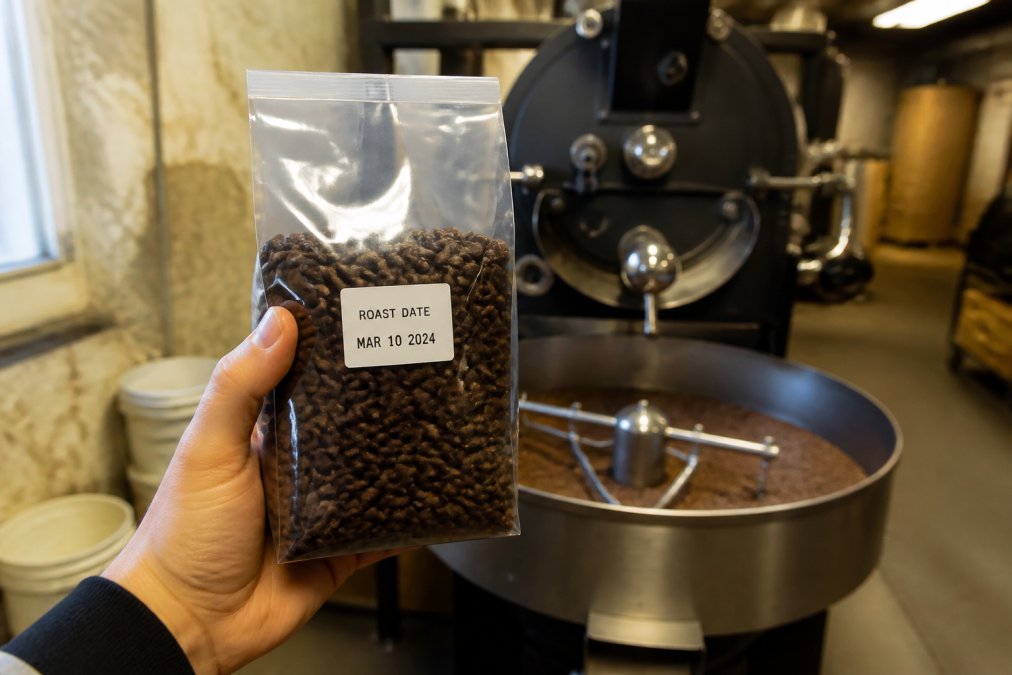
When coffee is roasted, it releases carbon dioxide in a process called degassing, which protects the beans from oxidation during the first days after roasting. The peak freshness window typically opens a few days after roasting and lasts roughly two to four weeks, depending on the bean and roast level.
A common mistake is assuming "best by" dates mean anything; they reflect shelf stability, not freshness.
For the freshest cup, look for beans roasted within the last two weeks. If you can't find a roast date, assume the coffee is already past its prime.
Fresh Roasted Coffee vs Grocery Store: A Direct Cost and Flavor Comparison
The debate between fresh roasted coffee vs grocery store options usually stalls on price. Grocery store coffee costs less per bag, but the value calculation changes when you compare price per cup and actual flavor.
| Factor | Fresh Roasted Coffee | Grocery Store Coffee |
|---|---|---|
| Roast date | Printed on bag, roasted days ago | Often absent, roasted months ago |
| Flavor clarity | Bright, complex, distinct notes | Flat, muted, one-dimensional |
| Aroma | Rich and fragrant | Weak or stale |
| Price per 12 oz bag | Around $18 | $8 to $12 |
| Cups per bag | 30 to 35 | 30 to 35 |
| Actual flavor yield | Full flavor from every cup | Diminished after the first week |
A 12 oz bag of Switchyard Blend from Mainline Roastery LLC costs $17.99 and yields roughly 30 cups, about 60 cents per cup at peak freshness. Grocery store beans might cost half as much per bag, but you're paying for beans that lost their aromatic compounds months ago.

The real difference comes down to what you value: raw bean weight or actual flavor delivered.
Specialty Coffee vs Commercial Coffee: What the Labels Actually Mean
Specialty coffee vs commercial coffee isn't just marketing jargon. Specialty coffee refers to beans that score 80 or above on the 100-point cupping scale used by the Specialty Coffee Association (sca.coffee). Commercial or commodity coffee is the lower-grade stuff that fills grocery store shelves.
Specialty beans are typically single origin or carefully blended, grown at higher altitudes, and processed with attention to quality. Commercial coffee is often a blend of commodity beans roasted dark to mask defects.
Specialty coffee is defined by traceability and quality control at every stage. Commercial coffee prioritizes consistency and low cost.
The practical result shows up in your cup: specialty coffee offers flavor clarity and distinct tasting notes, while commercial coffee delivers bitterness and little else.
How to Store Coffee Beans for Freshness at Home
Once you have fresh beans, proper storage determines how long the freshness lasts. The enemies are oxygen, light, heat, and moisture. How to store coffee beans for freshness comes down to controlling all four.
Store whole beans in an opaque, airtight container at room temperature, away from direct sunlight and heat sources. Never refrigerate or freeze beans you plan to use within a few weeks.
Grind only what you need immediately before brewing. Whole beans retain aromatic compounds far longer than ground coffee, which exposes dramatically more surface area to oxidation.
A common mistake is transferring beans to a clear glass jar for display. Keep beans in the bag they came in if it has a one-way valve, or move them to a ceramic or stainless steel container with a tight seal.
How to Identify Stale Coffee Beans
Most guides tell you to look for a weak bloom or a flat aroma, but those cues are subjective. To objectively verify staleness, run a structured test at home.
The At-Home Cupping Test
You'll need two bags: one with a visible roast date within the last two weeks, and one from a grocery store shelf without a roast date. Use the same grind size (medium-coarse, like sea salt) and the same water temperature (200-205°F) (nist.gov).
- Grind both coffees. Smell the grounds immediately. Fresh coffee should smell sweet and aromatic, think brown sugar, dried fruit, or toasted nuts. Stale coffee smells flat, papery, or faintly musty. Write down one word for each aroma.
- Add hot water. Pour water over both grounds simultaneously. Watch the crust that forms. Fresh coffee will swell and bubble vigorously as trapped carbon dioxide escapes. Stale coffee will barely rise, and the crust will look dense and inert.
- Break the crust. After four minutes, stir both cups with a spoon. The fresh coffee releases a burst of aroma. The stale coffee releases almost nothing. This step isolates the volatile compounds that carry flavor, if they're gone, no brewing method can bring them back.
- Taste side by side. Let both cups cool slightly, then slurp a spoonful of each. Focus on three attributes: acidity (brightness or sharpness), body (weight on the tongue), and finish (the aftertaste). Fresh coffee has a clean, sweet finish. Stale coffee leaves a bitter, ashy residue that lingers.
What the Test Reveals
The bloom is the most reliable single indicator. Fresh beans release up to twice their volume in carbon dioxide during the first minutes after grinding. Stale beans have already degassed, so the crust barely moves. If you're brewing a pour-over and the grounds don't visibly bloom, the beans are past their prime, regardless of what the package claims.
The Grind Test
Another quick check: grind a few beans and press the grounds between your fingers. Fresh grounds feel slightly oily and clump together. Stale grounds feel dry and powdery, because the oils have oxidized and evaporated. This test works even before you brew, making it useful at the store, though you'll need to buy the bag first.
Why Staleness Is Not Always Obvious
Dark roasts mask staleness better than light roasts, as the roasting process creates bitter compounds that cover up the flatness of old beans. This is why the structured test matters, it isolates the variables and forces a direct comparison.
Decoding Packaging Labels: What Roasters Hide
Packaging labels can mislead even experienced buyers. Decoding packaging labels means knowing which claims matter and which are decoration.
"Best by" dates, "packaged on" dates, and vague phrases like "roasted with care" tell you nothing. The only date that matters is the roast date.
Terms like "100% Arabica" sound impressive but mean little. Arabica is the baseline for quality coffee, and even commodity-grade Arabica exists. Look for origin information instead: a specific farm, cooperative, or at minimum a country and region.
"Small batch" and "artisan" are unregulated terms. What you want is verifiable information: roast date, origin, altitude, processing method, and tasting notes.
The Verdict: Matching Beans to Your Brewing Method
The freshness requirement is not uniform across brewing methods, which requires a look at extraction physics, specifically, how carbon dioxide and soluble solids behave under different pressures and contact times.
Espresso: Where Freshness Is Non-Negotiable
Espresso extraction operates at 9 bars of pressure, forcing water through finely ground coffee in 25-30 seconds (peer-reviewed research). Carbon dioxide in freshly roasted beans creates backpressure during extraction, stabilizing the flow rate and producing crema, the golden foam that carries aroma and body. Beans roasted more than three to four weeks ago have degassed significantly, so the shot runs faster, extracts unevenly, and produces a thin, sour-bitter shot with minimal crema.
For espresso, the optimal window is narrower than for other methods: roughly 5 to 14 days after roasting. Beans roasted yesterday are still degassing too aggressively, causing channeling and inconsistent extraction. This is why specialty cafes routinely rest espresso beans for several days before using them.
Pour-Over and Drip: Freshness Matters, but Timing Is Flexible
Pour-over and automatic drip brewers operate at atmospheric pressure with contact times of 2 to 4 minutes. The bloom phase, where hot water releases trapped carbon dioxide, is less critical for extraction than it is for espresso, but it still affects flavor clarity. Fresh beans (within 2 to 4 weeks of roasting) produce a cleaner, more defined cup because the volatile aromatic compounds are intact. Stale beans brew flat, but the difference is less dramatic than with espresso.
French Press and Cold Brew: The Forgiveness Zone
Immersion methods are the most forgiving of older beans for two reasons. First, the longer contact time (4 minutes for French press, 12-24 hours for cold brew) extracts more soluble solids, partially compensating for lost volatiles. Second, cold brew never uses heat, so extraction is driven entirely by time and solubility, not by aromatic compounds that require heat to release.
This doesn't mean stale beans are fine for cold brew; it means the sensory gap narrows. If you primarily brew cold brew, freshness is a nice-to-have rather than a necessity.
The Supply Chain Angle Most Articles Miss
The freshness gap between local roasters and grocery store beans is not just about time, it's about the distribution system. A grocery store bean travels through a regional warehouse, a distribution center, and a store shelf before reaching your cart, adding days or weeks of ambient storage.
This matters because beans peak between day 3 and day 21 after roasting. A bean that spends 10 days in transit and 14 days on a shelf is already past its prime before you open the bag.
Matching Beans to Your Routine
| Brewing Method | Freshness Sensitivity | Optimal Roast Age | Why |
|---|---|---|---|
| Espresso | Very high | 5-14 days | CO2 pressure drives crema and stable extraction |
| Pour-over / Drip | High | 3-21 days | Volatile aromatics need to be intact for clarity |
| French press | Moderate | 3-28 days | Longer contact time compensates for some loss |
| Cold brew | Low | 3-35 days | Time-based extraction is less dependent on volatiles |
For most home brewers, beans roasted within the past two weeks offer the best balance of flavor and stability. That's why buying from a local roastery that roasts to order, like Mainline Roastery LLC, makes a measurable difference. Our Switchyard Blend, a medium-dark roast of Caturra and Ethiopia Heirloom beans, is roasted to order and shipped the same day, so it arrives at peak freshness.
The choice between fresh roasted coffee and grocery store beans ultimately comes down to what you want from your morning cup. If you're satisfied with bitter, flat coffee that merely delivers caffeine, grocery store beans will do. If you want the full spectrum of flavors that coffee can offer, fresh roasted beans are worth the switch.
Frequently Asked Questions
Is fresh roasted coffee actually better than store-bought?
Yes, when you compare beans at their peak. Fresh roasted coffee has a distinct flavor window. The aromatic compounds that create flavor notes and acidity begin to fade immediately after roasting. Grocery store coffee often sits in a warehouse and on a shelf for weeks or months before you buy it. By that point, the coffee beans have lost much of their aroma and can taste flat or bitter.
How long does coffee stay fresh after roasting?
Most roasters agree that peak freshness occurs between 4 and 14 days after the roast date. The beans need a few days to degas carbon dioxide, which improves flavor clarity. After about 3 to 4 weeks, the flavor profile starts to dull noticeably. For the best cup, buy whole beans with a visible roast date and use them within a month of that date.
Why is grocery store coffee often cheaper than specialty coffee?
The price difference comes down to the supply chain and bean quality. Commercial coffee is often commodity coffee, grown at scale and traded on a global market. Specialty coffee uses higher-grade beans that are often single origin and traceable. You are paying for better bean quality, harvest selection, and a shorter supply chain, which means the coffee arrives fresher.
What are the signs of stale coffee beans?
The first sign is the smell. Fresh beans have a strong, sweet aroma. Stale beans smell musty or like cardboard. When you brew, the bloom should be a visible, bubbly expansion as the coffee releases carbon dioxide. A flat bloom with no bubbles is a clear sign of staleness. The flavor will also lack sweetness and have a dull, papery finish.