

Table of Contents
- Why 'Ethically Sourced' Is an Unregulated Term
- What Is Fair Trade Coffee and What Does It Guarantee?
- Coffee Certification Labels Explained: A Consumer's Guide
- Direct Trade Coffee Benefits and Where They Fall Short
- How to Read a Coffee Label for Supply Chain Transparency
- The Economic Breakdown of a Cup of Coffee
- How to Spot Greenwashing in Coffee Marketing
- Frequently Asked Questions
Last Updated: September 10, 2026
Why 'Ethically Sourced' Is an Unregulated Term
"Ethically sourced" is a marketing phrase, not a legal standard. No U.S. regulator defines it, audits it, or enforces it, which means ethical coffee sourcing can be claimed on a bag without proving a single claim behind it.
That gap is exactly why learning how to verify ethical coffee sourcing matters more now than it did a decade ago. Certification logos once did the heavy lifting for shoppers. Today, a growing share of roasters skip certification entirely and write their own sourcing story instead, which puts the burden of proof on you. At Mainline Roastery LLC, we understand customers want to know how a bag of single-origin beans actually got from a farm to their kitchen.
The good news: verification is learnable. It comes down to reading labels critically, understanding what certifications do and don't guarantee, and knowing which claims can be checked against public records.
What Is Fair Trade Coffee and What Does It Guarantee?
Fair trade coffee is coffee purchased under a certification system that sets a minimum price floor for farmers, adds a social premium for community projects, and requires independent audits of labor and environmental practices. It guarantees a price safety net and third-party inspection, not a specific quality level in the cup.
That distinction trips people up. Fair trade addresses economic responsibility at the farm level. It says nothing about roast profile, freshness, or flavor, which is why a fair trade label alone won't tell you whether the coffee tastes good.
How Fair Trade Pricing Works for Farmers
The mechanics are straightforward. A cooperatively organized farm sells through a certified exporter, receives at least the established floor price, and collects an additional premium paid into a communal fund. That fund typically finances schools, processing equipment, or organic conversion.
The limitation: the floor price functions as a baseline, not a living wage guarantee. A farm-gate price above the floor doesn't automatically cover a family's actual costs, and price premiums vary by region and harvest. Treat fair trade certification as a floor for labor rights and price stability, not a ceiling on what farmers earn.
Coffee Certification Labels Explained: A Consumer's Guide
Certification labels are your fastest filter, but each one covers a different slice of the supply chain. None of them verify everything, and that's the part most shoppers miss.
| Certification | What It Verifies | What It Doesn't Cover |
|---|---|---|
| Fair Trade | Minimum price, social premium, labor audits | Cup quality, roast freshness |
| USDA Organic | Cultivation practices, no synthetic pesticides | Farmer pay, labor conditions |
| Bird Friendly | Shade-grown habitat, biodiversity standards | Pricing, economic responsibility |
| Rainforest Alliance | Sustainability criteria, farm audits | Guaranteed price floor |
Fair Trade, Organic, Bird Friendly, and Rainforest Alliance
Each certification answers a different question. Fair Trade focuses on farmer-paid prices and cooperative structure. USDA Organic governs cultivation practices and processing method, verified through the USDA National Organic Program. Bird Friendly, administered through the Smithsonian, requires shade-grown cultivation that protects migratory bird habitat (nationalzoo.si.edu). Rainforest Alliance bundles environmental stewardship with social criteria and annual audits.
Stacking certifications gives you broader coverage, but it also raises costs, which is why many small roasters pursue direct trade relationships instead.
Direct Trade Coffee Benefits and Where They Fall Short
Direct trade coffee benefits buyers and farmers through shorter supply chains: roasters negotiate directly with producers, often paying above commodity coffee prices and visiting farms in person. The upside is real. The catch is that "direct trade" has no certifying body, no audit requirement, and no standard definition.
A roaster can claim direct trade after a single farm visit with no ongoing verification. That's not automatically dishonest, but it means you're trusting the roaster's word rather than a third party's audit. When a roaster publishes farm names, altitudes, processing methods, and the prices paid, that transparency substitutes for certification. When the label just says "direct trade" with no supporting detail, treat it as unverified.
How to Read a Coffee Label for Supply Chain Transparency
Reading a coffee label for supply chain transparency means checking five specific fields: origin specificity, farm or cooperative name, altitude, processing method, and roast date. A label that lists all five gives you something to verify. A label that lists none is a marketing exercise.
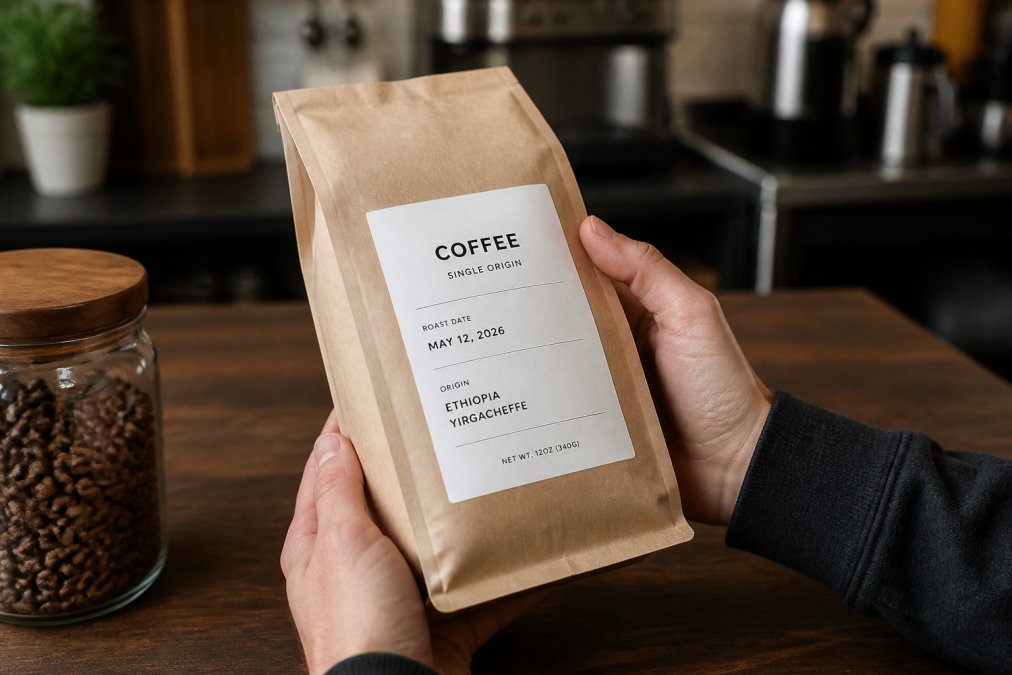
Here's a practical consumer audit framework you can run in under two minutes:
- Check origin specificity. "Ethiopia" is vague. "Yirgacheffe, Gedeb, Worka Chelbesa washing station" is traceable.
- Look for a farm or cooperative name. Named producers can be cross-referenced against importer and certification databases.
- Confirm the altitude. Altitude bands correlate with bean density and flavor, and they're hard to fake consistently across a product line.
- Identify the processing method. Washed, natural, honey, and anaerobic describe real production steps, not marketing language.
- Find the roast date. Not a "best by" date. A roast date tells you freshness, and freshness is the one claim a roaster can't outsource.
The Economic Breakdown of a Cup of Coffee
Where does your money actually go? Most guides stop at "the farmer gets very little." That's true but useless. To verify a sourcing claim, you need to know which line items in a cup's cost stack are visible to you and which are not.
Start with the benchmark. Green coffee trades against the "C price", the commodity futures price for washed arabica set on the Intercontinental Exchange (ICE). The C price is a global reference, not a farm-gate price. A producer's actual take is the FOB (free on board) price minus export, milling, transport, and cooperative fees. When the C price falls, the farm-gate price usually falls with it; when it rises, the farm-gate price often lags. That asymmetry is the structural reason commodity coffee is a poverty trap.
Now the retail stack. In a typical cafe, the largest cost lines are rent, labor, and equipment, not coffee. The green coffee itself is usually a modest fraction of the per-cup cost, and the farmer's share of that fraction is smaller still. Specialty coffee changes the math by paying a premium above the C price for quality and traceability, but even a strong premium is one line item in a long chain: producer, cooperative, exporter, importer, roaster, distributor, retailer.
What this means for verification:
- A high retail price is not evidence of a high farm-gate price. The two are only loosely coupled.
- The number that matters is the FOB or farm-gate price the roaster paid, expressed against the C price at the time of contract. Roasters who publish this are giving you something checkable.
- "Fair pricing" without a number is a slogan. A verifiable claim names the price, the benchmark, and the date.
This is why impact reporting from roasters matters more than a logo. A certification tells you a floor was met. A published price tells you what was actually paid.
How to Spot Greenwashing in Coffee Marketing
Greenwashing in coffee usually shows up in three places: vague certification language, imagery that implies a farm relationship the roaster can't document, and claims of "sustainable" or "ethical" sourcing with no audit trail. The FTC Green Guides set expectations for how environmental marketing claims should be substantiated, and coffee marketing is subject to those same principles.
But spotting greenwashing is only half the job. The harder half is confirming a claim is real. Here's a consumer audit you can run without leaving your kitchen.
Step 1: Separate fluff from data. Fluff is adjectives, "responsibly grown," "ethically sourced," "farm-direct," "hand-picked." Data is nouns and numbers, a producer name, a cooperative, an altitude, a harvest year, a processing method, a price, a certification body. If a bag has fluff but no data, you have nothing to verify.
Step 2: Cross-reference the producer. A named farm or cooperative can be checked against importer transparency reports and certification databases. If the roaster names a washing station, search that name alongside the importer. If nothing matches, the claim is unverified.
Step 3: Check the certification body, not just the logo. Legitimate certifications identify the standard and the auditor. A logo with no named certifying body is decoration.
Step 4: Look for lot-level detail. The strongest roasters publish lot numbers, harvest years, and processing details that let you trace a specific bag back to a specific harvest. That's the closest thing the industry has to a receipt.
Watch for these signals:
- Certification logos without a certifying body named. Legitimate certifications identify the standard and the auditor.
- "Ethically sourced" with no supporting detail. Unregulated and unverifiable on its own.
- No roast date or origin specifics. Transparency and freshness tend to travel together.
- Farm photos with no producer names. Imagery is not verification.
- A "sustainable" claim with no benchmark. Sustainability against what baseline, measured how?
For digital verification, check whether a roaster publishes lot-level information or links to importer transparency reports. Some roasters now share cooperative names, harvest years, and processing details that let you cross-reference claims against certification databases and importer records. That's the closest thing the industry has to a receipt.
Frequently Asked Questions
What are the most reliable certifications for ethical coffee?
Fair Trade, Organic, and Bird Friendly certifications carry the most weight because they require independent third-party audits. Fair Trade sets minimum farmer-paid prices and labor standards. Organic certification verifies cultivation practices without synthetic chemicals. Bird Friendly, issued by the Smithsonian Migratory Bird Center, requires shade-grown methods that protect habitats. A coffee carrying two or more of these certifications offers stronger verification than a single logo. Always check whether the certifying body conducts regular on-site farm audits.
How can consumers verify a coffee roaster's supply chain transparency?
Start by checking whether the roaster publishes origin-specific details: farm name, altitude, processing method, and farm-gate price paid. Look for impact reporting or annual sourcing reports on their website. Cross-reference certification numbers through the issuing body's online database. If a roaster claims direct trade coffee benefits but lists no farm names or cooperative partners, that is a red flag. Contact the roaster directly and ask how they audit their supply chain. Transparent roasters answer these questions without hesitation.
What is the difference between Fair Trade and direct trade coffee?
Fair Trade relies on third-party certification to set minimum prices, labor standards, and environmental requirements. Direct trade skips the certification body and instead builds direct relationships between roasters and farmers, often paying above Fair Trade minimums. Direct trade coffee benefits include fresher beans and more money reaching the farm, but it lacks independent audit verification. Fair Trade provides verifiable accountability; direct trade offers flexibility and potentially higher price premiums. The strongest sourcing programs combine elements of both.
Does a 'sustainably sourced' label guarantee ethical labor practices?
No. 'Sustainably sourced' is an unregulated marketing term in the United States. It may refer to environmental practices only, with no connection to fair labor conditions or living wage compensation. Unlike Fair Trade or Organic certification, no third-party audit backs the claim. To verify ethical coffee sourcing, look for specific certifications with published standards, named cooperatives, and traceable farm-gate prices. A vague sustainability claim without documentation should be treated as greenwashing until proven otherwise.
Verifying ethical coffee sourcing takes a few minutes per bag, and it's worth every one of them. At Mainline Roastery LLC, we roast fresh in Muscatine, Iowa, and we publish the origin, roast date, and sourcing details our customers ask about, because a bold flavor profile and an honest label should arrive in the same package. If you want specialty coffee you can actually trace, browse our single-origin lineup and see the difference transparency makes.