

Table of Contents
- Why the Coffee Aisle and the Roastery Sell Two Different Products
- Coffee Roast Date Importance: The One Label That Decides Everything
- How to Identify Specialty Coffee Grade Without Getting Fooled
- Single-Origin vs Blended Coffee: Which One Belongs in Your Mug
- Cost-Per-Cup: What Grocery Coffee Actually Costs You
- The Middle Ground: Local Roasters on Grocery Shelves
- Conclusion
- Frequently Asked Questions
Last Updated: September 18, 2026
Why the Coffee Aisle and the Roastery Sell Two Different Products
Specialty coffee vs grocery store brands isn't a fair fight, because the two categories are built around opposite goals. Grocery coffee is engineered for shelf stability and low cost. Specialty coffee is built for flavor, and flavor fades fast.
Walk down any grocery aisle and you'll see bags with no roast date, just a "best by" stamp that can stretch a year out. That's not an accident. Mass-market roasters buy commodity coffee in huge volumes, roast it dark enough to mask defects, and package it to survive months of distribution. At Mainline Roastery, we roast to order and ship the same day, because a roast date you can actually read tells you more than any marketing claim on the front of the bag.
Below, we'll break down the labels, grades, and real costs so you can tell which bag is worth your money.
Coffee Roast Date Importance: The One Label That Decides Everything
The roast date is the single most useful number on a coffee bag, and most grocery brands simply don't print one. Coffee starts losing aroma and flavor within days of roasting as oxygen exposure drives oxidation. A "best by" date set a year out tells you nothing about when the beans were actually roasted.
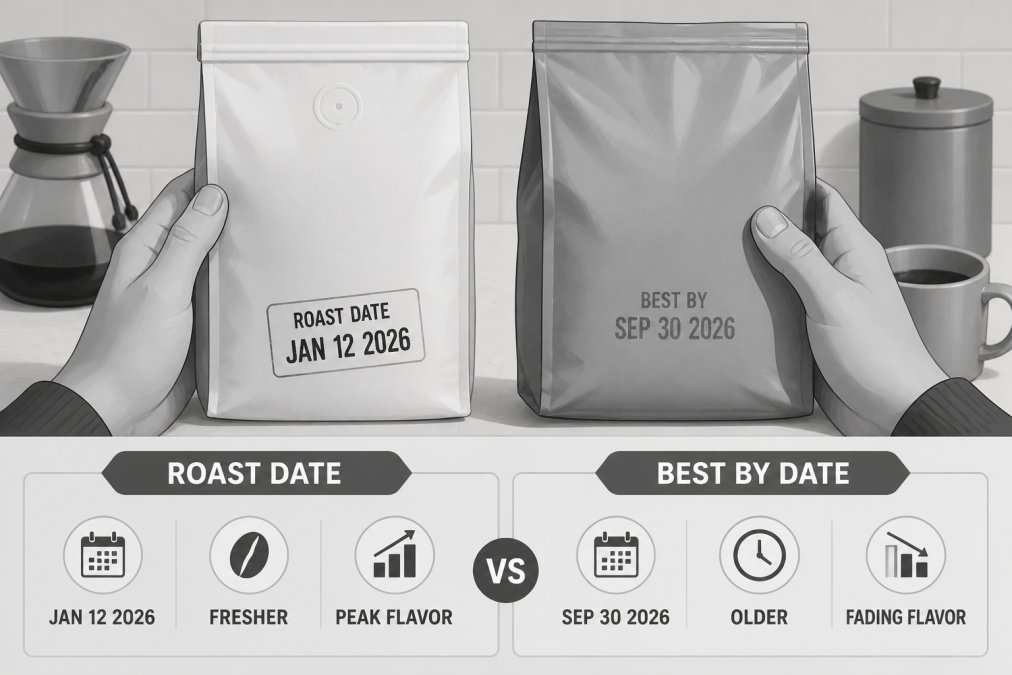
Here's what to look for:
- A printed roast date, not just a best-by date
- Whole bean over pre-ground, since grinding speeds up staling
- A bag that lists the harvest cycle or processing method
- A valve or sealed packaging that limits oxygen exposure
How to Identify Specialty Coffee Grade Without Getting Fooled
Specialty grade is a measurable standard, not a marketing word. Coffee is graded on a 100-point scale by licensed evaluators, and specialty grade requires a cupping score of 80 or higher, according to Specialty Coffee Association grading standards. Anything below that is commodity coffee.
So how do you spot it on a shelf?
- Look for a stated cupping score or grade
- Check for single-origin or named-farm sourcing
- Look for supply chain transparency details
- Avoid vague terms like "gourmet" or "premium"
A common mistake is assuming a dark roast means stronger coffee. It usually just means more bitterness from over-roasting, which hides defects rather than highlighting quality.
Single-Origin vs Blended Coffee: Which One Belongs in Your Mug
Single-origin coffee comes from one region, farm, or cooperative, while blends combine beans from multiple sources. Neither is automatically better, but the two formats exist for very different reasons, and understanding those reasons tells you a lot about what's in the bag.
Why blends exist. Coffee is an agricultural product. A single farm's crop changes every harvest, rainfall, altitude, processing method, and storage all shift the flavor. A roaster who wants a house blend that tastes the same in March as it did in October has to blend across origins and adjust proportions as crops change. Blends are also a cost tool: a roaster can anchor a blend with a lower-cost base bean and lift it with a smaller proportion of a higher-scoring origin. That's not inherently bad, a well-built blend can be excellent, but it means the label tells you less about what you're drinking.
Why single-origin exists. A single-origin bag is a snapshot. It's how you taste what a specific region, altitude, or processing method actually does to a bean, the jasmine and bergamot of a washed Ethiopian, the brown sugar and red apple of a Guatemalan, the earthy depth of a wet-hulled Sumatran. The trade-off is variability: this year's lot may taste noticeably different from last year's, and a bad harvest can mean a disappointing bag.
| Factor | Single-Origin | Blended |
|---|---|---|
| Flavor | Distinct, region-specific, changes by harvest | Balanced, engineered for consistency |
| Consistency | Varies year to year | Repeatable across crops |
| Cost driver | Scarcity and lot quality | Base bean cost plus accent beans |
| Label transparency | Usually names farm, region, or cooperative | Often lists origins but not proportions |
| Best for | Pour-over, tasting, exploring | Drip, espresso, everyday brewing, offices |
| Risk | A weak harvest shows through | A weak component can be masked |
How this plays out in grocery vs. specialty. Mass-market grocery coffee is almost always a blend, and often a dark roast, because blending and dark roasting are the two most reliable ways to make a consistent product from commodity beans whose quality varies. That's a feature of the business model, not a flaw in the beans. Specialty roasters, by contrast, tend to lead with single-origins because their customers are paying for traceability and flavor distinction, and they use blends for the everyday, espresso, and subscription products where consistency matters more than novelty.
Switchyard Blend Medium-Dark Roast →
Which should you buy? If you want to taste what a specific region actually offers, go single-origin and check the roast date, because a stale single-origin loses the delicate notes that justify the price. If you want a dependable cup every morning without thinking about it, a well-built blend delivers, and a fresh blend from a roast-to-order roaster will beat a stale single-origin every time.
Mainline's Switchyard Blend, for example, combines Caturra and Ethiopia Heirloom beans for notes of bittersweet chocolate and candied orange, roasted to order and shipped the same day. It's a blend built for consistency, not a blend built to hide defects, and the roast date on the bag is how you tell the difference.

Cost-Per-Cup: What Grocery Coffee Actually Costs You
Cost-per-cup is the honest way to compare coffee, and it often flips the "specialty is expensive" assumption, but only if you actually run the math instead of comparing bag prices. The formula is simple: divide the bag price by the number of cups the bag yields. The variable most people get wrong is yield.
Yield depends on your dose and your brew ratio. A common starting point is a 1:15 ratio by weight, roughly 18 grams of coffee to 270 grams of water, which produces about one 9 oz mug.
| Bag type | Typical 12 oz price | Cups per bag (1:15) | Cost per cup |
|---|---|---|---|
| Mass-market grocery (pre-ground, no roast date) | $8-$12 | 18-19 | $0.42-$0.63 |
| Local roaster on a grocery shelf | $12-$16 | 18-19 | $0.63-$0.84 |
| Roast-to-order specialty (whole bean) | $16-$22 | 18-19 | $0.84-$1.16 |
- Buy whole bean. Pre-ground stales in days, so you waste more of the bag.
- Weigh your dose. Eyeballing a scoop can swing your yield by 20% or more.
- Match bag size to your pace. A 12 oz bag lasts about two to three weeks at one cup a day. If you drink less, buy smaller bags more often rather than letting a large bag fade.
- Freeze the surplus. Whole bean coffee freezes well in an airtight container; portion it so you only thaw what you'll use in a week.
Run the numbers on a $17.99 bag of Mainline's Switchyard Blend at the 1:15 ratio and you land near $0.95 per cup, squarely in the roast-to-order tier, but with a roast date you can read and a bag that hasn't sat in a distribution center for months.
The Middle Ground: Local Roasters on Grocery Shelves
A growing number of regional roasters now sell through grocery and specialty retail, which blurs the old divide. These small-batch roasters often print roast dates and name their sources, giving you specialty quality without a separate subscription.
Conclusion
The gap between specialty coffee and grocery store brands comes down to freshness, transparency, and how the beans were graded and roasted. Once you know to check the roast date, the grade, and the cost per cup, the choice gets a lot clearer.
Frequently Asked Questions
What is the difference between specialty coffee and commercial grocery store coffee?
Specialty coffee is graded on a 100-point scale and must score 80 or higher, according to the Specialty Coffee Association. Commercial grocery coffee rarely publishes a score and is often roasted months before it reaches the shelf, so it loses aroma and complexity. Specialty coffee is also tied to a specific harvest cycle and processing method, while mass-market bags blend beans from many origins with no traceable roast date.
Does the roast date on coffee bags actually matter for flavor?
Yes, and it matters more than most labels on the bag. Coffee roast date importance comes down to oxidation: once beans are roasted, they start losing aroma and developing stale, flat flavors. Whole bean coffee holds up longer than pre-ground because less surface area is exposed to air. Bags with only a best-by date, usually 9 to 12 months out, tell you nothing about when the coffee was actually roasted.
How do I identify specialty coffee grade when I'm standing in the store?
Look for three things: a printed roast date within the last few weeks, a stated origin or farm rather than a vague regional blend, and a cupping score or specialty grade claim. If a bag says nothing about when it was roasted or where the beans came from, treat it as commodity coffee. Single-origin bags with a harvest year and processing method listed are the easiest to verify.
Is specialty coffee worth the higher price compared to grocery brands?
Run the cost-per-cup math. A 12 oz bag of specialty beans at $17.99 brewed at a 1:15 ratio yields roughly 18 to 19 cups, or about $0.95 to $1.00 per cup. Grocery coffee looks cheaper per bag, but you often use more grounds to compensate for flat flavor. Freshly roasted beans also extract more consistently, so you waste fewer brews dialing in your grind.