

Table of Contents
- Specialty Coffee vs Commercial Coffee: What Sets Them Apart
- The Role of Bean Quality, Origin, and Terroir
- Coffee Bean Freshness and Flavor: Why Roast Date Matters
- How Processing Methods Shape the Flavor Profile
- Mastering Brewing Variables for Better Extraction
- How to Brew Specialty Coffee at Home
- Water Chemistry, Mouthfeel, and the Science of Flavor
- Frequently Asked Questions
Last Updated: September 13, 2026
Specialty Coffee vs Commercial Coffee: What Sets Them Apart
Specialty coffee scores 80 points or higher on the Specialty Coffee Association's 100-point scale, and that score is why it tastes better (Standards). Commercial coffee lands in the 60s and 70s, where dark roasting masks defects and flattens flavor. This guide from Mainline Roastery LLC breaks down why specialty coffee tastes better, from bean selection to final pour.
The difference starts before roasting. Commercial operations buy commodity-grade beans in bulk, roast them dark to hide inconsistencies, and ship them with no meaningful roast date. Specialty roasters work the opposite way: they source higher-scoring lots, roast to preserve origin character, and get the coffee to you fast. According to Specialty Coffee Association's coffee standards, grading involves evaluating everything from bean defects to cup clarity, sweetness, and acidity balance.
Most guides treat "specialty" as a marketing label. It's a measurable grade.
| Factor | Commercial Coffee | Specialty Coffee |
|---|---|---|
| Quality score | Below 80 points | 80+ points |
| Roast level | Dark, uniform | Precise to bean |
| Roast date | Rarely printed | Printed and tracked |
| Origin info | Blended, anonymous | Traceable farm/lot |
| Flavor goal | Consistency | Distinctiveness |
The Role of Bean Quality, Origin, and Terroir
Bean quality sets the ceiling of what a cup can taste like, and no brewing skill can raise it. A high-scoring bean grown at altitude in volcanic soil carries more sugar density and complexity than a commodity bean grown for volume. That's terroir: soil, altitude, shade, and climate shaping flavor before the coffee is ever picked.
A common mistake is assuming all single-origin beans are specialty. Origin tells you where coffee came from, not how it scored; a washed Ethiopian heirloom lot and a generic "Ethiopian" blend can differ enormously. Bean density matters too, denser, higher-elevation beans roast more evenly and hold sweetness through extraction.
At Mainline Roastery LLC, we build blends like the Switchyard Blend around specific lots: Caturra and Ethiopia Heirloom beans sourced from East Africa and South America. The origin isn't decoration. It's the flavor architecture.

Coffee Bean Freshness and Flavor: Why Roast Date Matters
Coffee bean freshness and flavor are directly linked, and roast date is the most useful number on a bag. Freshly roasted beans still contain aromatic oils and trapped carbon dioxide that carry flavor into the cup; within weeks, oxidation breaks those compounds down. Coffee doesn't spoil in the food-safety sense, but it goes stale, losing sweetness, acidity, and aroma in that order.
"Best by" dates tell you almost nothing, a bag stamped six months out was likely roasted months ago. A roast date tells you exactly how old the coffee is, which is why specialty roasters print it.
How Processing Methods Shape the Flavor Profile
Processing methods determine how much fruit, sugar, and acidity survive from cherry to green bean, leaving a distinct fingerprint on flavor. The mechanism is fermentation: naturally occurring yeasts and bacteria consume sugars and produce acids, alcohols, and esters, the same aromatic compounds that give wine and beer their character.
The three traditional methods differ mainly in how much fruit contact the bean gets before drying:
- Washed process: Fruit is removed within hours of picking, then the bean is fermented in a tank of water for 12-36 hours to break down remaining mucilage before drying. Result: clean, bright, high acidity. Best for showcasing terroir because nothing masks it.
- Natural process: The whole cherry dries on the bean for two to four weeks, with the fruit fermenting around it the entire time. Result: heavier body, berry and fermented sweetness, sometimes a wine-like or boozy note. Higher risk of defect if the drying bed is not turned regularly.
- Honey process: Skin removed, but some or all of the sticky mucilage left on the bean during drying. The name refers to the mucilage's honey-like texture, not flavor. Result: middle ground, syrupy sweetness with balanced acidity. Classified by how much mucilage remains: white, yellow, red, black honey, in ascending order of fruit contact.
A washed Ethiopian and a natural Ethiopian from the same farm can taste like two different coffees. Neither is better; they express different things, and processing is often the reason behind a bag's tasting notes.
The experimental tier
Over the past decade, a fourth category has moved from novelty to mainstream in specialty coffee: controlled fermentation, borrowed directly from winemaking.
- Anaerobic fermentation: Beans (with or without fruit) are sealed in airtight tanks with a one-way valve, so oxygen is consumed and carbon dioxide builds pressure. The low-oxygen environment favors different microbial activity and produces distinct tropical, spicy, or lactic notes. Common in Colombia, Costa Rica, and Panama.
- Carbonic maceration: Whole cherries are sealed under a CO2 blanket, a technique adapted from Beaujolais winemaking. The cherries ferment from the inside out before the bean is extracted. Result: intensely fruity, often with a cinnamon or bubblegum character.
- Yeast inoculation: Producers add specific commercial yeast strains (often Saccharomyces cerevisiae) to steer fermentation toward a target flavor. This is the most controversial method because it blurs the line between terroir and manufacturing.
These methods are polarizing, thrilling to some, closer to a fruit smoothie than coffee to others, but common enough that a specialty roaster's menu will usually label them explicitly.
Why processing is a flavor decision, not a quality decision
A common misconception is that washed coffee is "higher quality" than natural. It isn't. Processing is a style choice, and a poorly executed washed coffee can score lower than a well-executed natural. What processing does affect is consistency and risk: washed coffees are more predictable lot to lot, while naturals and experimental ferments vary more and demand more producer skill.
Mastering Brewing Variables for Better Extraction
Brewing variables decide whether you taste the quality you paid for. Extraction yield, the percentage of coffee solids dissolved into water, is the number that matters. Under-extract and you get sour, thin coffee; over-extract and you get bitter, harsh coffee. Four variables control that narrow sweet spot.
- Grind consistency: A burr grinder produces even particles so water extracts them at the same rate. Blade grinders create fines and boulders, causing uneven extraction.
- Water temperature: Between 195°F and 205°F. Too cool under-extracts; too hot scorches.
- Ratio: Start at 1:16 coffee to water by weight, then adjust to taste.
- Time: Pour-over typically runs 2:30 to 3:30 total, including the bloom.
The bloom, that initial pour that lets trapped CO2 escape, matters more with fresh coffee. Stale beans barely bloom. Fresh specialty beans puff up and release aroma, a quick visual confirmation you're working with something good.
How to Brew Specialty Coffee at Home
Brewing specialty coffee at home comes down to four things: grind, water, ratio, and time. Get those right and you'll out-brew most cafés.
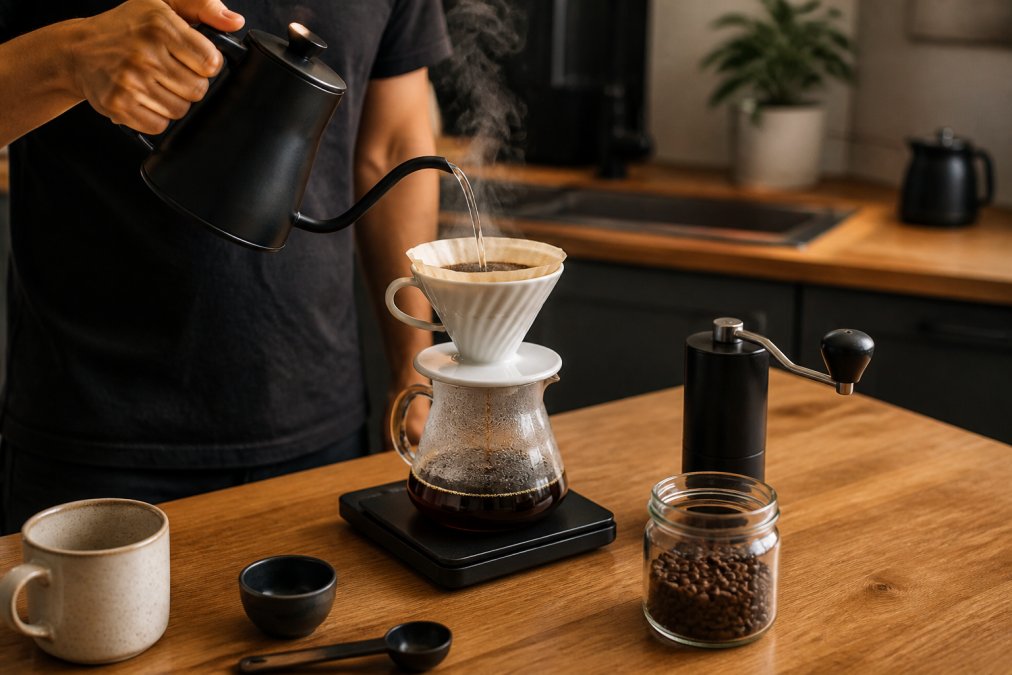
- Weigh your beans. Use 1 gram of coffee per 16 grams of water. For a 12 oz cup, that's roughly 22 grams of coffee.
- Grind fresh. Grind medium-fine for pour-over, medium for drip. Grind right before brewing to preserve aromatic oils.
- Heat water to 200°F. Just off boil. Let it rest a moment if you don't have a temperature-controlled kettle.
- Bloom the grounds. Pour twice the coffee's weight in water, wait 30 seconds.
- Pour in stages. Add water in slow circles, keeping the bed even. Finish by 3 minutes.
- Taste and adjust. Sour means grind finer. Bitter means grind coarser.
Total time: about 8 minutes. Difficulty: beginner-friendly with a scale and burr grinder.
Water Chemistry, Mouthfeel, and the Science of Flavor
Water chemistry is the variable almost nobody talks about, and it changes everything. Brewed coffee is roughly 98% water, so dissolved minerals, not just the beans, determine what reaches your tongue. The Specialty Coffee Association publishes a water quality handbook for this reason, and competition-level baristas treat water as a controllable ingredient.
The two numbers that matter most are hardness and alkalinity. Hardness is the total concentration of dissolved calcium and magnesium, usually expressed in ppm as calcium carbonate equivalent. Alkalinity is the water's capacity to buffer acids, essentially how much bicarbonate is present. They are not the same thing, and conflating them is the most common home-brewing mistake.
- Too little hardness (under ~50 ppm): Water is too soft to pull flavor compounds efficiently. The cup tastes hollow, flat, and thin, like the coffee is missing its middle.
- Too much hardness (over ~175 ppm): Minerals overwhelm the palate. The cup tastes chalky, muted, and can leave a drying sensation.
- Too much alkalinity (over ~80 ppm): Bicarbonate neutralizes the coffee's natural acids. Brightness disappears, and a washed Kenyan that should taste like grapefruit tastes like wet cardboard.
- Too little alkalinity: The cup can taste sharp or astringent because nothing is buffering the acids.
A widely cited target among specialty practitioners is roughly 50-175 ppm hardness and 40-80 ppm alkalinity, with a pH near neutral. Magnesium is preferred over calcium for extraction because it binds flavor compounds more readily, some roasters add a little Epsom salt (magnesium sulfate) to distilled water to hit this target.
The chloride-to-sulfate ratio is the second lever. Sulfate-heavy water tends to push bitterness and dryness forward; chloride-heavy water rounds out sweetness and body. Neither is right or wrong, it's a dial. A common starting point is roughly a 1:1 ratio, adjusted to taste.
Mouthfeel is not flavor
Mouthfeel is the tactile sensation of coffee on the tongue, distinct from flavor. Flavor is what you taste; mouthfeel is how it feels. A natural-process coffee might be syrupy and coating, while a washed coffee feels lighter and cleaner, almost tea-like. Sensory analysis separates the two because they are genuinely different experiences, and aftertaste lingers after you swallow, telling you how clean or complex the finish is.
Three physical properties drive mouthfeel:
- Body, dissolved and suspended solids, including lipids and polysaccharides from the bean.
- Astringency, a drying, puckering sensation from tannin-like compounds, usually a sign of over-extraction or water that is too alkaline.
- Viscosity, the actual thickness of the liquid, which correlates with extraction strength and the coffee's natural sugar content.
Frequently Asked Questions
What defines specialty coffee according to the Specialty Coffee Association?
The Specialty Coffee Association (SCA) defines specialty coffee as beans scoring 80 points or higher on a 100-point scale. Certified Q Graders evaluate factors like flavor, acidity, sweetness, mouthfeel, and aftertaste. Only about 10% of the world's coffee meets this standard. The score reflects bean quality, proper harvesting, processing, and roasting precision, all of which contribute to why specialty coffee tastes better than commodity-grade coffee.
Why does specialty coffee taste less bitter than commercial coffee?
Specialty coffee tastes less bitter for three main reasons. First, specialty beans are selectively harvested at peak ripeness, avoiding the unripe and overripe beans that create harsh flavors. Second, precise roasting develops sweetness and aromatic oils without scorching the beans. Third, specialty coffee is brewed with controlled brewing variables like water temperature and grind consistency. Commercial coffee often uses lower-grade beans, darker roasts that mask defects, and inconsistent brewing, all of which increase bitterness.
How can I replicate specialty coffee shop quality at home?
Start with freshly roasted specialty beans from a roaster that ships within days of roasting, like Mainline Roastery's Switchyard Blend. Use a burr grinder for even grind consistency, weigh your coffee and water for the correct ratio (typically 1:15 to 1:17), and heat water to 195-205°F. A pour-over setup with a gooseneck kettle gives you control over extraction yield. Finally, use filtered water with balanced total dissolved solids (TDS) around 150 ppm for the best flavor.
Does the origin of the coffee bean really change the flavor?
Yes, origin dramatically affects flavor profile. Ethiopian beans often show floral and fruity tasting notes, Colombian beans bring caramel sweetness and mild acidity, and Sumatran beans offer earthy, full-bodied character. Factors like terroir (soil, altitude, climate), bean density, and processing methods all influence the final cup. Single-origin specialty coffees highlight these distinct characteristics, while blends combine origins to create balanced, consistent flavor profiles.