

Table of Contents
- Why That Grocery Store Bag Tastes Flat Before You Open It
- Coffee Roast Date Importance: The Label That Actually Matters
- How to Store Coffee Beans for Maximum Freshness at Home
- Signs of Stale Coffee Beans You Can Spot in Seconds
- Cost Comparison: Grocery Store vs Specialty Coffee
- How to Get Fresh Coffee Without Wasting Money
- Conclusion
- Frequently Asked Questions
Last Updated: September 27, 2026
Why That Grocery Store Bag Tastes Flat Before You Open It
Most bags of stale grocery coffee were roasted months before you bought them. That gap is why so many people end up pouring money into coffee they never enjoy. This guide from Mainline Roastery LLC explains how to stop wasting money on stale grocery coffee and get a better cup for less.
Coffee starts losing flavor the moment it leaves the roaster. Oxygen, light, and moisture all speed up that decline.
Here is what happens inside the bag:
- Oxidation: Oxygen reacts with the oils in the beans.
- Degassing: Beans release carbon dioxide, then go flat.
- Moisture: Damp air kills the crispness in the roast.
- Light exposure: Bright light breaks down flavor compounds.
A grocery bag can sit in a warehouse, then a truck, then a shelf. By the time it reaches your kitchen, the best flavor is already gone.
The U.S. Department of Agriculture food storage guidance notes that oxygen and moisture are the main drivers of food quality loss over time. Coffee is no exception.
Coffee Roast Date Importance: The Label That Actually Matters
The roast date is the single most useful number on any coffee bag. It tells you when the clock started ticking on flavor. A "best by" date does not. Most grocery coffee guides stop there. This section goes further: how to actually read the label in the aisle and decide whether the bag is worth your money.
Here is the difference:
- Roast date: When the beans were actually roasted. Printed as a specific day, like "Roasted 03/14."
- Best by date: A seller's guess at peak quality, often set months out. It says nothing about when the beans were roasted.
- Sell by date: A retail rotation tool, not a freshness measure.
- Lot or batch codes: Encoded production dates that most shoppers cannot decode without a key.
How to Read a Grocery Coffee Label in Under a Minute
- Look for a printed roast date first. If it is there, you are already ahead. Subtract it from today.
- If there is no roast date, look for a "best by" date and work backward. Many roasters set best-by windows of six to twelve months. A bag stamped "Best By" ten months out was likely roasted months ago.
- Treat undated bags as a red flag. If a roaster is proud of how fresh the coffee is, they print the date. A missing date usually means the coffee is older than the seller wants you to know.
- Check the roast level against the date.
- Squeeze the bag if it has a one-way valve. A fresh bag will feel firm or slightly inflated from escaping carbon dioxide. A soft, limp bag has likely finished degassing.
Why This Matters for Your Wallet
A bag with no roast date is a gamble. You might get coffee roasted last week. You might get coffee roasted last spring. The price is the same either way, but the value is not. Paying full price for a bag that is already past its peak is the quiet way grocery coffee wastes your money.
How to Store Coffee Beans for Maximum Freshness at Home
Learning how to store coffee beans for maximum freshness comes down to three things: keep them cool, dark, and dry. Do that and your beans hold their flavor far longer.
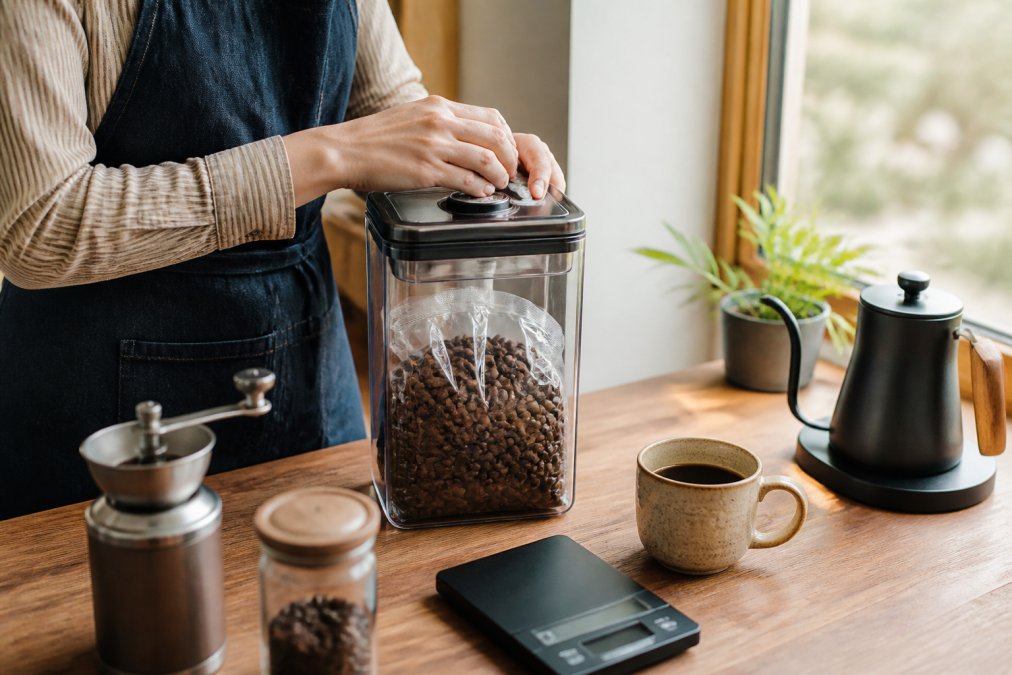
Use this simple routine:
- Buy whole bean. Grind right before brewing.
- Move beans to an airtight container. Push out as much air as you can.
- Store away from light. A dark cabinet beats a clear jar on the counter.
- Keep them cool and dry. Avoid the warm spot above the fridge.
- Skip the freezer for daily use. Freezing works for long-term storage, but repeated thawing adds moisture.
Signs of Stale Coffee Beans You Can Spot in Seconds
Spotting signs of stale coffee beans takes seconds once you know what to look for. If any of these show up, the coffee is past its best.
Check for:
- No smell. Fresh beans hit you with aroma. Stale beans smell like cardboard.
- Oily or dull surface. A dried-out, lifeless look is a warning sign.
- Flat taste. The brew tastes weak, bitter, or just boring.
- No bloom. Pour hot water on fresh grounds and they puff up. Stale grounds sit still.
Cost Comparison: Grocery Store vs Specialty Coffee
A cost comparison of grocery store vs specialty coffee usually surprises people. The cheap bag is not always the better deal once you factor in waste. But the more useful comparison, the one most guides skip, is subscription versus bulk buying. That is where the real money math lives.
The Waste-Adjusted Cost of a Cup
The sticker price per ounce is only half the story. The other half is how much of the bag you actually drink. Here is the trade-off:
Switchyard Blend Medium-Dark Roast →
| Factor | Grocery Store Coffee | Fresh Specialty Coffee |
|---|---|---|
| Price per ounce | Lower upfront | Higher upfront |
| Roast date | Often missing | Printed clearly |
| Shelf life left | Often short | Long |
| Flavor | Flat, inconsistent | Bold, consistent |
| Waste | High (poured out) | Low |
Subscription vs. Bulk Buying: The Real Financial Breakdown
This is the comparison most articles avoid because it is not a simple answer. Both models can save money, or waste it, depending on how you drink.
The subscription model:
- Beans ship close to the roast date, so almost none of the bag is wasted to staleness.
- You pay a predictable amount on a set schedule, which makes budgeting easier.
- The trade-off is shipping cost and less flexibility. If you drink less one month, you may end up with a backlog.
- Best for: households that drink coffee daily and want consistent freshness without thinking about it.
The bulk-buying model:
- The per-ounce price drops when you buy larger quantities, and there is no shipping if you buy locally.
- The catch is storage. Bulk only saves money if you can keep the beans fresh long enough to drink them. Otherwise you are just buying more stale coffee.
- Best for: households that drink a lot of coffee, have proper airtight or vacuum storage, and can finish a large bag within a few weeks.
The hybrid approach:
- Buy a small amount of fresh coffee for daily drinking and keep a sealed backup for emergencies.
- This avoids both the subscription backlog and the bulk-staleness trap.
- It is usually the most forgiving option for households with unpredictable consumption.
How to Run Your Own Numbers
You do not need a spreadsheet, just three inputs:
- How many cups you brew per week. Be honest. Most people overestimate.
- How many cups one bag yields.
- How much of each bag you actually finish. If you routinely toss the last quarter, that is waste you can price in.
Divide the bag price by the cups you actually drink, not the cups the bag could theoretically make. That number, cost per good cup, is the only one that matters. Price per ounce matters, but so does price per good cup. A bag you actually finish beats a bargain you throw away.
How to Get Fresh Coffee Without Wasting Money
Getting fresh coffee without wasting money is easier than most people think. You just have to buy smarter and store better.
Try these steps:
- Buy smaller amounts more often. Freshness beats bulk.
- Check the roast date every time. Walk away from undated bags.
- Grind at home. Whole bean stays fresh longer.
- Store in an airtight or vacuum container. Keep it cool, dark, and dry.
- Consider a coffee subscription. Beans ship right after roasting.
Conclusion
The real problem is not that grocery coffee is cheap. It is that you pay for flavor you never get.
Frequently Asked Questions
How can you tell if grocery store coffee is fresh?
Check the bag for a roast date, not just a best-by date. If it only shows a best-by month, assume the beans were roasted months earlier. Fresh whole beans also smell sweet and roasty, feel firm, and release visible gas when you open the bag. If the beans smell like cardboard or paper, they are past their peak. Buying from a roaster that ships same day, like Mainline Roastery, gives you a verifiable roast date.
Does coffee actually expire if it has been sitting on a shelf?
Coffee does not spoil in a food-safety sense, but it goes stale. Once roasted, beans begin losing aroma and flavor within days. Oxygen, light, heat, and moisture speed up oxidation, which turns the oils rancid and flattens the taste. A bag sitting on a grocery shelf for months is safe to drink, but it will taste dull and papery.
What is the best way to store coffee beans to maintain freshness?
Keep whole beans in an airtight, opaque container in a cool, dark, dry spot away from the stove. Avoid the fridge, because moisture and food odors creep in every time you open the door.
Is it cheaper to buy coffee directly from a roaster?
Per ounce, grocery coffee often looks cheaper, but you may toss half a bag that went stale before you finished it. Direct-from-roaster coffee arrives fresh, so you use every gram. For example, Mainline Roastery's Switchyard Blend is $17.99 for a 12 oz bag, shipped the same day it is roasted. When you factor in less waste and better flavor, the price per good cup is often lower than the grocery shelf.