

Table of Contents
- Start With the Bag: Why the Original Valve Bag Matters
- The Four Enemies of Freshness: Light, Heat, Moisture, and Oxygen
- How to Tell if Coffee Beans Are Fresh
- How Long Do Coffee Beans Stay Fresh?
- Best Coffee Storage Canisters: What to Look For
- Freezing Coffee Beans for Long Term Storage
- How to Store Specialty Coffee Beans: Daily Practices That Protect Flavor
- Grinding and Storage: When to Grind for Best Results
- Frequently Asked Questions
Last Updated: September 23, 2026
Start With the Bag: Why the Original Valve Bag Matters
When learning how to store specialty coffee beans, the best container is often the bag they arrived in. Specialty roasters use one-way valve bags that let carbon dioxide escape while keeping oxygen out.
Freshly roasted beans release carbon dioxide for days after roasting, a process called degassing. Without a valve, that gas builds up inside the bag.
At Mainline Roastery LLC, we ship every order in a valve bag for this exact reason: it protects the beans from roaster to seal.
The catch: the valve only helps while the bag stays sealed. Once you cut it open, squeeze out the air and clip it shut.
- Keep the bag sealed until you're ready to brew
- Store it upright so the valve isn't blocked
- Reseal with a clip after every use
- Check the roast date before you buy anything
The Four Enemies of Freshness: Light, Heat, Moisture, and Oxygen
Four things destroy coffee: light, heat, moisture, and oxygen. Together they turn a bright, sweet roast into a flat, cardboard-like cup.
Light breaks down the surface oils that carry much of the aroma and flavor you paid for.
How to Tell if Coffee Beans Are Fresh
Fresh beans tell you they're fresh in several ways, no special equipment needed.
- Strong aroma when you open the bag
- Oily sheen on the bean surface
- A visible bloom when you brew
- Bright, complex flavor in the cup
How Long Do Coffee Beans Stay Fresh?
Whole bean coffee stays fresh for about two to four weeks after the roast date when stored properly, then flavor drops off quickly. Ground coffee goes stale in days, not weeks, because more surface area is exposed to air.
Here's a rough timeline to work from:
| Storage Method | Peak Freshness | Still Good | Notes |
|---|---|---|---|
| Sealed valve bag, room temp | 2-4 weeks | Up to 6 weeks | Best for daily drinkers |
| Airtight opaque canister | 2-3 weeks | Up to 4 weeks | Depends on seal quality |
| Clear jar on counter | 3-7 days | 1-2 weeks | Light and air do damage fast |
| Freezer, sealed portions | 4-8 weeks | Up to 3 months | Must be airtight and thawed right |
| Pre-ground coffee | 1-3 days | 1 week | Surface area speeds staling |
Best Coffee Storage Canisters: What to Look For
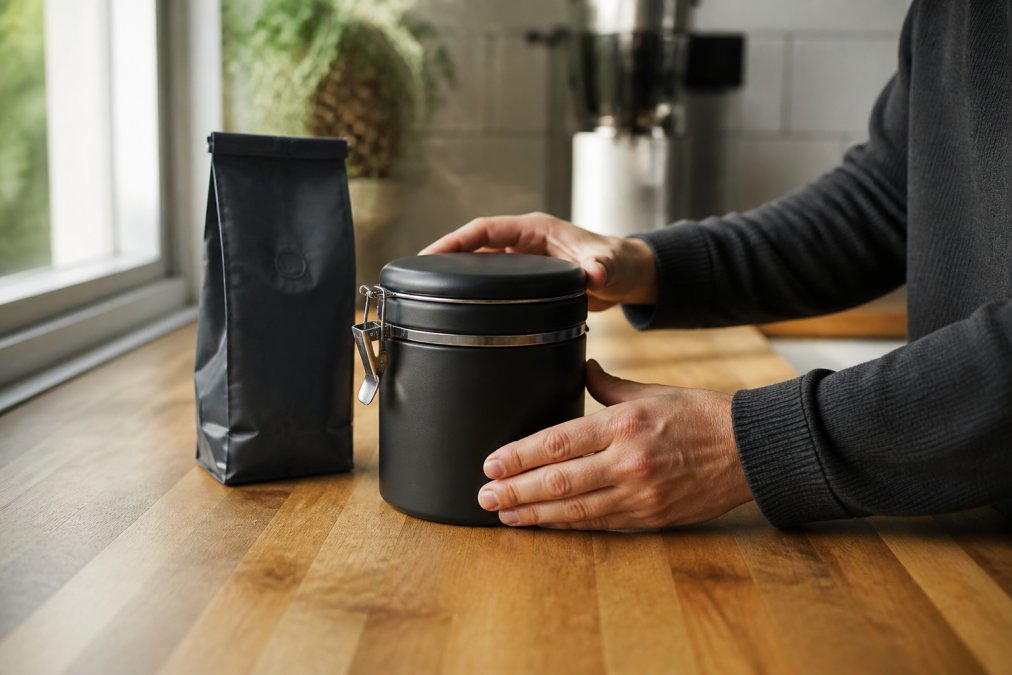
The best coffee storage canister is opaque, airtight, and sized to hold only what you'll drink in a few weeks. Those three traits matter more than brand or price, but the material also changes how long the beans hold up.
Materials That Protect Flavor
Stainless steel and ceramic are the two best materials for coffee storage. Both block light completely and don't hold odors, but they behave differently over weeks of daily use.
| Material | Blocks Light | Oxygen Barrier | Odor Retention | Durability |
|---|---|---|---|---|
| Stainless steel | Yes | Excellent | None | High |
| Ceramic (opaque) | Yes | Excellent | None | Medium |
| Glass (opaque/tinted) | Yes | Excellent | None | Medium |
| Plastic (food-grade) | Only if opaque | Fair | Some | Low |
Why Clear Jars Fail
Clear jars fail because light destroys the oils that carry flavor. Even indirect sunlight breaks down those compounds over days, and the damage is cumulative, a week on a bright counter costs noticeably more aroma than a cabinet.
Freezing Coffee Beans for Long Term Storage
Freezing coffee beans for long term storage works, but only if you do it right. The freezer is for bulk orders and backup bags, not daily-use beans.
How to Freeze Without Ruining the Beans
Follow these steps to freeze beans without wrecking them:
- Divide fresh beans into portions you'll use in one week
- Seal each portion in an airtight, freezer-safe bag
- Squeeze out as much air as possible before sealing
- Label each bag with the roast date
- Place bags in the coldest part of the freezer, not the door
- Pull one portion at a time and let it sit sealed at room temp for 30 minutes
- Grind only after the beans reach room temperature
That last step matters. Grinding cold beans can produce an uneven grind, and opening the bag too early lets condensation form on the beans.
How to Store Specialty Coffee Beans: Daily Practices That Protect Flavor
Storing specialty coffee beans well comes down to a few small habits. Get these right and you'll taste the difference in every cup. But the habits that work in a mild, dry kitchen don't all translate to a humid coastal apartment or a high-altitude mountain town, and that's where most guides go quiet.
- Buy in two-week amounts
- Reseal after every scoop
- Keep beans whole until brew time
- Replace your stash before it goes flat
Where to Keep Your Beans: Pantry and Cupboard Placement
The best spot is a cool, dark cupboard away from heat. Aim for a steady room temperature and no direct sunlight.
Humidity: The Variable Most Guides Ignore
In a humid climate, moisture creeps into any container that isn't fully sealed. Coffee beans are hygroscopic, they pull water vapor out of the air, and once moisture is inside the bean, it accelerates the reactions that flatten flavor and can invite mold.
A few adjustments help in humid conditions:
- Use a canister with a silicone gasket, not a friction-fit lid. Gaskets hold a seal against pressure changes; friction lids don't.
- Add a small food-safe desiccant packet to the canister. It absorbs stray moisture without touching the beans. Swap it out every few weeks, or when the indicator (if it has one) changes color.
- Keep the canister out of the bathroom-adjacent cabinet and away from the dishwasher, both of which spike local humidity.
- Buy smaller amounts. The longer beans sit in a humid environment, the more moisture they take on.
Altitude: Why Beans Degas Faster Up High
At higher elevations, lower air pressure means gases expand more readily. Beans that are still degassing release carbon dioxide faster, and the one-way valve on the original bag has to work harder to keep oxygen out. The practical result is that beans can go stale sooner than the roast-date timeline suggests.
What helps at altitude:
- Move beans into an airtight canister sooner after opening. The valve bag is less effective when ambient pressure is low.
- Expect a shorter peak window, closer to the two-week end of the range than the four-week end.
- Keep the canister in the coolest, most stable spot you have. Temperature swings compound the pressure effect.
- If you freeze, portion smaller. Faster degassing means each thaw cycle costs you more aroma.
Travel and Small-Space Storage Solutions
Travel storage needs one thing above all: a hard, sealed container. Soft bags get crushed in a pack, and crushed beans go stale faster because more surface area is exposed.
Grinding and Storage: When to Grind for Best Results
Grind right before you brew. That's the rule, and it matters more than almost any container choice.
Frequently Asked Questions
What is the 15-15-15 coffee rule?
The 15-15-15 rule is a simple guideline for enjoying coffee at its best: use beans within 15 days of the roast date, store them in an airtight container at room temperature, and brew within 15 minutes of grinding. While some specialty beans peak between 4 and 14 days after roasting, sticking to this rule helps you avoid stale flavors and keeps your daily cup consistent.
Do coffee beans go bad after 2 years?
Yes, coffee beans lose most of their flavor long before two years. Whole beans stay fresh for about 2 to 4 weeks after opening, and unopened bags keep well for 3 to 6 months past the roast date. After that, oxidation and moisture exposure make the beans taste flat and papery. Freezing can extend shelf life, but even frozen beans are best used within 6 months.
Is it okay to store coffee beans in a Ziploc bag?
A Ziploc bag is better than nothing but not ideal. Standard plastic bags are not fully airtight, so oxygen and moisture get in, and they offer no protection from light. If you must use one, press out as much air as possible and keep it in a dark cupboard. For real freshness, transfer beans to an opaque, airtight canister or leave them in the original valve bag.
Is it better to keep coffee beans in the fridge or freezer?
The freezer is the better choice for long-term storage. The fridge exposes beans to moisture, odors, and temperature swings every time the door opens. For freezing coffee beans for long term storage, use an airtight, moisture-proof container and only take out what you need. Let frozen beans come to room temperature before grinding to avoid condensation.
Great coffee starts with great beans, and great beans deserve better than a clear jar on a sunny shelf. Mainline Roastery LLC roasts fresh in Muscatine, Iowa, and ships in valve-sealed bags that protect flavor from our roaster to your kitchen. We offer bold blends and single-origin beans, delivered fast so your first cup tastes as good as your last. Get started with Mainline Roastery LLC and brew coffee that holds its flavor from the first scoop to the final one.