

Table of Contents
- Why Fresh Roasted Coffee Shipping Times Matter for Flavor
- How to Tell If Coffee Beans Are Fresh Before You Order
- The Coffee Degassing Period and Why It Affects Shipping
- Standard Shipping Timelines: From Roastery to Doorstep
- Local Delivery vs. National Shipping: What Changes
- Weather, Regional Zones, and the Routes That Slow Coffee Down
- The Best Way to Store Coffee Beans After Delivery
- Subscriptions, Wholesale Orders, and Tracking Your Delivery
- Frequently Asked Questions
Last Updated: September 19, 2026
Why Fresh Roasted Coffee Shipping Times Matter for Flavor
Coffee starts losing its best flavor the moment it leaves the roaster. That is why fresh roasted coffee shipping times matter so much: the gap between roast day and your doorstep decides how good your next cup actually tastes. At Mainline Roastery LLC, we roast to order and ship the same day, because a bean that sits in a warehouse for three weeks is already past its prime.
How to Tell If Coffee Beans Are Fresh Before You Order
Fresh beans show three clear signs: a recent roast date, a one-way degassing valve on the bag, and a strong aroma when opened. If a listing hides the roast date, that is your first warning sign.
Here is what to check before you buy:
- Roast date printed clearly on the bag, not just a best-by date
- A degassing valve that lets carbon dioxide escape without letting air in
- Whole bean over pre-ground, since grinding speeds up staling
- Roast-to-order language on the product page
- Shipping policy that states how fast orders leave the roastery
Reading the Roast Date, Not the Best-By Date
The roast date is the only number that matters for flavor. Best-by dates often stretch months into the future and say nothing about when the beans were actually roasted.
The Coffee Degassing Period and Why It Affects Shipping
The coffee degassing period is the window after roasting when beans release carbon dioxide trapped during the roast. It typically runs 4 to 7 days for filter roasts and 7 to 14 days for espresso roasts, though darker roasts degas faster than light ones. Here is the angle most shipping guides miss: transit time is not a delay you tolerate, it is a rest period you benefit from.
How Roasters Time Dispatch Around Degassing
Most roasters rest beans for a short period before shipping, but the exact window depends on roast level and brew method. This lets the worst of the gas escape while keeping peak flavor intact.
- Rest window: 12 to 48 hours after roasting before the bag ships, for most medium and dark roasts
- Peak drinking window: roughly 4 to 14 days post-roast for drip, 7 to 21 days for espresso
- Too early: gas interferes with extraction and the cup tastes sharp or hollow
- Too late: oxidation takes over and the bright acids fade into cardboard
Why the One-Way Valve Is the Whole Mechanism
That little button on the bag is a one-way degassing valve. It lets CO2 escape so the bag does not balloon and burst, but it blocks outside oxygen from getting in. Without it, a freshly roasted bag would either inflate like a pillow or, if sealed tight, trap gas that ruins the cup. The valve is why a sealed bag can still be "breathing", and why you should never squeeze the bag to smell the coffee, since that pushes aroma oils out through the valve.
Standard Shipping Timelines: From Roastery to Doorstep
A typical fresh roasted coffee order moves through four stages: order processing, dispatch, carrier transit, and final delivery. Most orders arrive within a few business days of roasting, though that varies by carrier and distance.
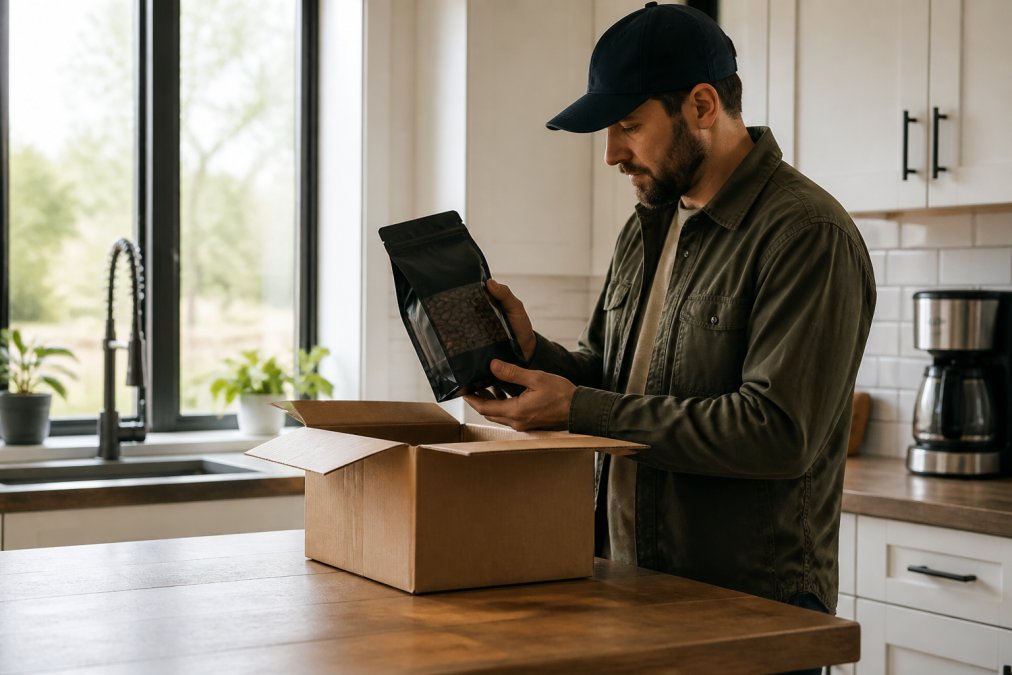
Here is how the stages stack up:
| Stage | What Happens | Typical Timing |
|---|---|---|
| Order processing | Order confirmed, beans roasted to order | Same day to 1 business day |
| Dispatch | Shipping label created, bag sealed | Same day to next business day |
| Carrier transit | Ground or priority delivery in motion | 1-5 business days |
| Final delivery | Package arrives at your door | Per carrier estimate |
Order Cutoff Times, Business Days, and Carrier Transit
Business days exclude weekends and holidays, so a Friday afternoon order rarely moves until Monday. Miss the cutoff time and your order waits a full day.
- Cutoff time: the daily deadline to ship same day
- Business days: Monday through Friday, minus holidays
- Transit time: the carrier's travel estimate, not counting processing
- Estimated arrival: processing plus transit, combined
Local Delivery vs. National Shipping: What Changes
Local delivery skips the carrier entirely, so coffee can arrive within a day of roasting. National shipping adds transit time but reaches anywhere in the country.
- Local delivery: fastest, often next-day, minimal handling
- National shipping: wider reach, longer transit, more sorting stops
- Origin hub: where the shipment first enters the carrier network
- Shipping zone: distance bands that set transit speed and cost
Weather, Regional Zones, and the Routes That Slow Coffee Down
Weather and distance are the two biggest wildcards in coffee shipping, and they interact. A storm in a major hub like Memphis or Louisville does not just delay packages bound for that city, it ripples through the whole carrier network, because those hubs sort freight for entire regions. A two-day priority package can sit three extra days in a facility 1,500 miles from its destination.
How Temperature and Humidity Affect Beans in Transit
Whole bean coffee is hygroscopic, it absorbs moisture from the air. A sealed bag with a one-way valve slows that down, but it does not stop it. In practice:
- Sustained heat above roughly 90°F accelerates oxidation and can push oils to the surface of darker roasts, leaving them greasy and stale on arrival
- High humidity softens beans and dulls acidity, especially if the bag seal is compromised
- Freeze-thaw cycles in winter transit can pull condensation into the bag as it warms in your mailbox
- Direct sun on a delivery truck dashboard or porch is worse than ambient heat because it spikes surface temperature fast
Regional Transit Zones: What to Expect by Distance
Carriers price and route ground shipments by zone, measured from the origin ZIP code. The farther the zone, the more days in transit and the more sorting hubs the package passes through. A rough framework for a roastery in the middle of the country:
| Zone | Approximate Distance | Typical Ground Transit |
|---|---|---|
| Local | Same metro area | 1 business day |
| Regional | 1-2 states away | 1-2 business days |
| Mid-distance | 3-5 states away | 2-3 business days |
| Cross-country | Coast to coast | 4-5 business days |
Peak Season, Storms, and the Practical Workarounds
Holiday volume from late November through December slows every carrier, and a single winter storm can add two to four days to any route passing through an affected hub. Summer heat waves do the same to bean quality even when the package arrives on time.
- Order earlier than you think you need to during peak season, a week of buffer is not excessive
- Choose expedited shipping in extreme heat or cold if the beans matter for a specific date
- Track the package and bring it inside promptly, a box baking on a porch undoes good packaging fast
- Check the roast date on arrival, not just the delivery scan, to confirm the beans are still in their window
The Best Way to Store Coffee Beans After Delivery
The best way to store coffee beans is in an airtight, opaque container at room temperature, away from light, heat, and moisture. Done right, beans hold peak flavor for a couple of weeks after opening.
- Airtight container: keeps oxygen out
- Cool, dark spot: away from the stove and sunlight
- Whole bean: grind right before brewing
- Small batches: buy what you will drink in a few weeks
Freezing, Vacuum Sealing, and the One Mistake to Avoid
Freezing works well for longer storage if you seal beans airtight and thaw them fully before brewing. Vacuum sealing removes oxygen and slows staling.
Subscriptions, Wholesale Orders, and Tracking Your Delivery
A subscription program locks in a regular delivery so fresh coffee arrives before you run out. Wholesale orders work the same way, just in larger volumes for cafes and offices.
- Subscriptions: set your frequency, get fresh beans on schedule
- Wholesale: bulk orders for break rooms and cafes
- Tracking: follow each shipment in real time
- Fulfillment: the roastery's process for packing and sending orders
Frequently Asked Questions
Do roasters ship coffee the same day it is roasted?
Many roast-to-order roasteries do. Mainline Roastery roasts the Switchyard Blend to order and ships it the same day, so the bag leaves the roastery rather than sitting in a warehouse. That matters because coffee shipping times only tell part of the story: a fast carrier cannot fix beans that sat on a shelf for weeks before dispatch. Check whether the roaster prints a roast date and whether same-day dispatch is standard or occasional.
How long should you wait to brew coffee after it is roasted?
Give whole beans 3 to 7 days to finish the coffee degassing period, then brew. During degassing, beans release carbon dioxide, which makes espresso pull unevenly and pour-over bloom aggressively. Most medium and dark roasts settle within 3 to 5 days; lighter roasts can take a week. If your bag arrives 2 to 4 days after the roast date, it is often ready to brew on arrival or within a day or two.
Does shipping time affect the freshness of coffee beans?
Yes, but less than most people assume. Whole beans hold peak flavor for roughly 2 to 4 weeks after the roast date when stored away from air, light, heat, and moisture. A 3 to 5 day transit window costs little if the coffee was roasted and dispatched promptly. The bigger risk is a long gap between roast date and dispatch, or a bag that sits in a hot delivery truck or mailbox after arrival.
How can you tell if your coffee was roasted recently?
Look for a printed roast date on the bag, not a best-by date. A best-by date is typically set 6 to 12 months out and says nothing about when the beans were roasted. Fresh whole beans also smell sweet and aromatic when the bag is opened, feel dry rather than oily on the surface for medium roasts, and produce a lively bloom when hot water hits them. If the bag has no roast date at all, treat that as a warning sign.
Fresh coffee only stays fresh if it reaches you fast. Mainline Roastery LLC roasts to order and ships the same day, so your beans arrive near peak flavor instead of sitting in a warehouse. With specialty blends, single-origin options, and wholesale support for local businesses, we make fresh coffee simple. Get started with Mainline Roastery LLC and taste the difference a short roast-to-door gap makes.