

Table of Contents
- Why Proper Storage Matters for Roasted Coffee Beans
- The Best Container for Storing Coffee Beans: Airtight Coffee Storage Container Options
- How Long Do Roasted Coffee Beans Stay Fresh
- The Four Enemies of Coffee Freshness: Air, Moisture, Heat, and Light
- Should Coffee Beans Be Refrigerated or Frozen
- How to Tell If Coffee Beans Are Fresh
- Storage Tips for Different Climates and Household Conditions
- Frequently Asked Questions
Last Updated: October 10, 2026
Why Proper Storage Matters for Roasted Coffee Beans
Once you store roasted coffee beans, they start degrading the moment they leave the roaster. Oxygen, moisture, heat, and light attack the oils and compounds that give your coffee its bold flavor and rich aroma. At Mainline Roastery LLC, we roast to order and ship the same day because we know freshness is everything. But what happens after the beans arrive at your door depends entirely on how you store them.
Proper storage preserves the fresh-roasted quality from the moment you open the bag. Beans stored properly stay vibrant for weeks; beans left exposed go flat in days.
The Best Container for Storing Coffee Beans: Airtight Coffee Storage Container Options
The right container seals tight, blocks light, and keeps moisture out.
Vacuum-Sealed Canisters
Vacuum-sealed canisters remove most air via a pump mechanism, creating a low-oxygen environment where beans stay fresh longer. Choose stainless steel or opaque plastic, clear glass exposes beans to light. Quality vacuum canisters cost $15-$40 and last for years.
Original Bags with One-Way Valves
Most specialty roasters, including Mainline Roastery LLC, ship beans in bags with one-way valves that let CO₂ escape but prevent air from entering. Keep the bag sealed between uses by folding and clipping the top. This works well for beans used within 2-3 weeks; for longer storage, transfer to a vacuum canister.
Glass and Ceramic Containers
Glass and ceramic canisters with rubber gaskets or silicone seals keep light out and look attractive, but don't remove oxygen. Test the seal by filling with water and inverting over a sink, if water leaks, the seal isn't tight enough.
How Long Do Roasted Coffee Beans Stay Fresh
Roasted coffee beans stay fresh for 2-4 weeks if stored properly, with peak flavor in the first 1-2 weeks. The roast date matters more than the expiration date, beans roasted yesterday are fresher than beans roasted three weeks ago, even if both expire on the same day. Mainline Roastery LLC includes the roast date on every bag.
The Four Enemies of Coffee Freshness: Air, Moisture, Heat, and Light
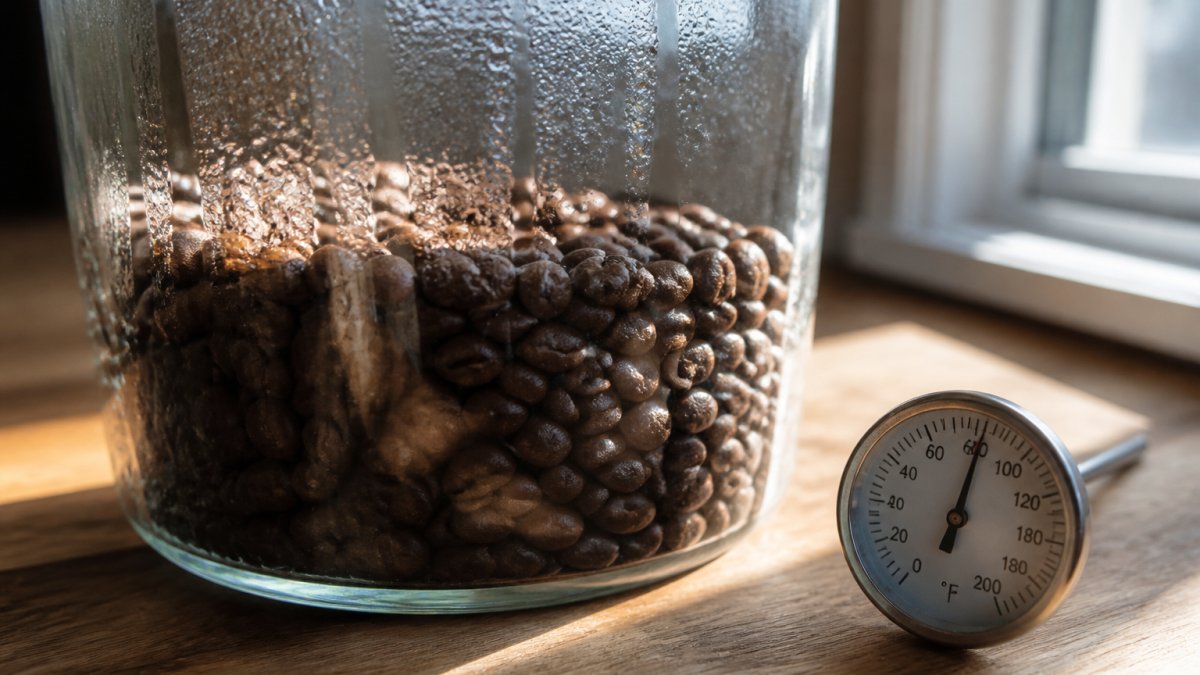
Four factors degrade coffee: Air and oxygen break down flavor and aroma compounds, vacuum-sealed containers slow this by removing oxygen. Moisture dilutes flavor and causes mold; avoid humid bathrooms and areas above stoves. Heat accelerates degradation; store in cool cabinets or closets, ideally below 70°F. Light breaks down flavor compounds; use opaque containers and keep beans away from windows.
Should Coffee Beans Be Refrigerated or Frozen
Refrigeration usually hurts more than it helps, but freezing can work if done properly.
Why Refrigeration Is Not Recommended
Refrigerators are humid; temperature swings cause condensation on beans, promoting mold and flavor absorption from other foods. Cold also slows the degassing process fresh beans need in their first week. Store beans in a cool, dark pantry instead, or a closet if your kitchen exceeds 75°F.
Freezing Coffee Beans: A Practical Protocol
Freezing preserves beans for 3-4 months by minimizing air and moisture exposure. Portion beans into small amounts, use airtight freezer-safe containers, remove excess air, label with roast date, thaw completely in the sealed container (1-2 hours), and grind immediately. The freeze-thaw cycle affects beans slightly but beats room-temperature storage for long-term preservation.
How to Tell If Coffee Beans Are Fresh
Freshness exists on a spectrum, not as a binary state. Understanding how beans change over time helps you recognize when storage has failed and when beans are still worth brewing.
The Roast Date: Your Primary Indicator
The roast date is the most reliable freshness marker. Beans roasted within the last 7 days are in their peak flavor window. Beans roasted 2-3 weeks ago are still good but noticeably flatter. Beans roasted more than 4 weeks ago taste significantly diminished, even in perfect storage.
If a bag does not display a roast date, ask the roaster or seller. Any specialty roaster will provide this information. Expiration dates are less useful because they often reflect legal requirements rather than actual flavor decline. Two bags with the same expiration date can taste dramatically different if one was roasted 5 days before that date and the other was roasted 25 days before.
Aroma: The First Sign of Degradation
Fresh beans smell vibrant and complex. Open a bag of freshly roasted beans and you'll notice immediate, bold aroma, fruity, nutty, chocolatey, or floral notes depending on the roast profile.
Stale beans smell flat, muted, or musty. If you open a bag and the aroma is weak or absent, the beans have lost volatile aromatic compounds. This is often the first sign of staleness, appearing before flavor loss becomes obvious in the cup.
A practical test: smell the beans immediately after opening the bag, then smell them again after 10 seconds. Fresh beans maintain strong aroma. Stale beans smell noticeably weaker on the second sniff because the volatile compounds dissipate quickly once exposed to air.
Appearance: Color and Surface Texture
Fresh beans have a consistent, rich color appropriate to their roast level. Light roasts appear tan or light brown. Medium roasts are medium brown. Dark roasts are dark brown or nearly black. The color should be uniform across the batch.
Stale beans often develop a dull, grayish cast or appear faded. This happens because oxidation breaks down the pigments in the bean surface. Darker roasts may look ashy or dusty rather than glossy.
Surface texture also changes. Fresh beans, especially darker roasts, have a slightly oily appearance because the roasting process brings oils to the surface. This is normal and desirable. Stale beans look dry, dusty, or chalky. If beans appear to have a white film or powder on the surface, they may have developed mold due to moisture exposure, discard them.
Brewing Behavior: How Staleness Appears in the Cup
As beans age, brewing behavior changes in predictable ways:
Bloom phase (first 30 seconds of pouring water). Fresh beans bloom vigorously, releasing visible carbon dioxide bubbles and expanding noticeably. Stale beans bloom weakly or not at all. A weak bloom is a strong indicator that beans have lost freshness.
Switchyard Blend Medium-Dark Roast Coffee 12 oz →
Extraction speed. Fresh beans extract more slowly because they're denser and more resistant to water penetration. Stale beans extract faster because oxidation has made the bean structure more porous. If your usual brewing time produces under-extracted (sour) coffee, staleness may be the culprit, the beans are extracting too quickly.
Flavor profile. Fresh beans taste bright, complex, and balanced. Stale beans taste flat, muted, or one-dimensional. Acidity fades first, followed by sweetness and body. If your coffee tastes thin or lacks the flavor notes you remember from a previous bag, staleness is likely responsible.
Crema (espresso). If you pull espresso shots, fresh beans produce thick, stable crema that lasts 1-2 minutes. Stale beans produce thin, short-lived crema or none at all.
Troubleshooting: When Storage Has Failed
Beans smell musty or moldy. This indicates moisture exposure. Discard the beans. Moisture creates conditions for mold growth, which is a food safety risk.
Beans smell rancid or like old oil. This indicates oxidation has progressed too far. The beans are safe to drink but will taste unpleasant. Improve your storage method for future purchases.
Beans look wet or have visible condensation inside the container. This is a sign of improper thawing (if frozen) or exposure to humidity. Transfer beans to a fresh, dry container immediately. If condensation reappears within hours, your storage container is not airtight, switch to a vacuum-sealed canister or sealed glass container with a rubber gasket.
Beans taste sour or thin despite being within the freshness window. Check your roast date. If beans are less than 5 days old, they may still be degassing and are not yet at peak flavor. Wait 3-5 more days before brewing. If beans are older than 5 days and taste sour, your storage temperature may be too warm (above 75°F), accelerating degradation. Move beans to a cooler location.
Storage Tips for Different Climates and Household Conditions
Storage needs change based on your environment. Hot, humid climates present different challenges than cool, dry ones.
In hot climates: Keep beans in the coolest part of your home, away from windows and heat sources. A basement or interior closet works better than a kitchen cabinet. Consider vacuum-sealed storage or freezing if your home regularly exceeds 75°F.
In humid climates: Moisture is your main enemy. Use vacuum-sealed canisters or airtight glass containers with rubber gaskets. Check containers regularly for condensation inside. If you see moisture, transfer beans to a fresh container immediately.
In dry climates: Your storage is easier. Airtight containers work well. Original bags with one-way valves are often sufficient if you use the beans within 2-3 weeks.
In small spaces: A cool closet or cabinet beats a kitchen counter. Keep beans away from appliances that generate heat. If you have limited cabinet space, portion beans into smaller containers and freeze the extras.
For wholesale or office use: If you're ordering from Mainline Roastery LLC for your office or cafe, store beans in a cool back room or storage closet. Use vacuum canisters for bulk storage.
| Storage Method | Best For | Duration | Pros | Cons |
|---|---|---|---|---|
| Original bag, sealed | Weekly use | 2-3 weeks | Convenient, no extra cost | Exposed to light when opened |
| Vacuum canister | Regular drinkers | 3-4 weeks | Removes oxygen, long-lasting | Initial cost, takes space |
| Glass/ceramic with seal | Display storage | 2-3 weeks | Attractive, effective seal | Doesn't remove oxygen |
| Freezer storage | Long-term | 3-4 months | Extends freshness significantly | Requires thaw protocol |
Knowing how to store roasted coffee beans is straightforward once you understand what degrades them. Air, moisture, heat, and light are the enemies. An airtight container in a cool, dark place solves most storage problems.
When you order from Mainline Roastery LLC, your beans arrive roasted fresh and shipped the same day. The Switchyard Blend Medium-Dark Roast arrives packed with the bold flavor and rich aroma that make specialty coffee worth buying. Proper storage preserves that quality from the moment you open the bag.

National Coffee Association guidelines on storage
Specialty Coffee Association best practices
FDA guidance on food storage and shelf life
Frequently Asked Questions
How long do roasted coffee beans stay fresh after opening?
Roasted coffee beans peak in flavor for about 2-4 weeks after the roast date when stored properly in an airtight container. Whole beans maintain their freshness longer than ground coffee. After opening a bag, consume the beans within 2-3 weeks for optimal taste. Check the roast date on your bag, freshly roasted beans like Switchyard Blend, roasted to order and shipped the same day, give you the longest window of peak flavor.
Should roasted coffee beans be stored in an airtight container?
Yes. An airtight coffee storage container is essential because oxygen causes coffee to go stale. Whole beans release carbon dioxide after roasting, and exposure to air accelerates flavor loss. Vacuum-sealed canisters, original bags with one-way valves, or glass containers with tight-fitting lids all work well. The key is eliminating air exchange while protecting beans from moisture, heat, and light.
Is it better to store coffee beans in the fridge or freezer?
Refrigeration is not recommended because temperature fluctuations and moisture in the fridge degrade flavor and cause condensation when beans warm up. Freezing can work if done correctly: store beans in an airtight container in the freezer for up to 3 months, and remove only the amount you need without thawing the rest. Let frozen beans come to room temperature in a sealed container before opening to prevent condensation. A cool, dark pantry remains the best option.
How can I tell if my roasted coffee beans are still fresh?
Fresh beans smell vibrant and aromatic. Stale beans smell flat or musty. Brew a small amount: fresh beans produce a rich crema and bold flavor. If the cup tastes flat, sour, or lacks complexity, the beans have lost freshness and should be replaced.