

Table of Contents
- How to Store Coffee Beans to Preserve Flavor: The Core Rules
- How Long Do Coffee Beans Stay Fresh After Roasting?
- Can You Freeze Coffee Beans? A Practical Protocol
- Choosing an Airtight Coffee Storage Container
- Coffee Beans Storage Mistakes That Kill Flavor
- Storage by Freshness Stage and Household Conditions
- Frequently Asked Questions
Last Updated: October 9, 2026
How to Store Coffee Beans to Preserve Flavor: The Core Rules
If you want to know how to store coffee beans to preserve flavor, the answer comes down to one principle: keep whole beans away from air, moisture, heat, and light until the moment you grind them.
That single habit protects more flavor than any gadget on the market. At Mainline Roastery LLC, we roast to order and ship the same day, so our beans reach you near peak freshness. What happens next is up to your kitchen.
Here's the part most guides skip: coffee starts losing aroma the day it's roasted, not the day you open the bag. Below, we'll cover the four enemies of freshness, a real freezing protocol, and the storage mistakes that quietly flatten your morning cup.
Coffee bean storage is the practice of protecting roasted whole beans from oxygen, moisture, heat, and light so their volatile aroma compounds survive until brewing.
The Four Enemies: Air, Moisture, Heat, and Light
Oxygen is the biggest threat. It reacts with the oils on the bean surface and turns bright, sweet notes into cardboard and stale coffee.
Moisture runs second. Humidity in the air makes beans soft and dull, and it speeds up the staling process.
Heat pushes those reactions faster. A bag sitting next to the stove ages in days, not weeks. Light breaks down the oils too, which is why clear glass jars on a sunny counter are a bad idea.
- Air: oxidizes oils, kills aroma
- Moisture: softens beans, speeds staling
- Heat: doubles the rate of flavor loss
- Light: degrades oils, especially sunlight
Keep all four out, and you've solved most of the problem.
How Long Do Coffee Beans Stay Fresh After Roasting?
Whole beans hit their flavor peak roughly 4 to 14 days after roasting and stay good for about 2 to 6 weeks when stored well. Ground coffee goes stale in days, not weeks, because far more surface area meets the air.
The roast date matters more than the "best by" label. That label often reflects packaging, not freshness. Look for the roast date stamped on the bag, and buy from roasters who print one.
Reading the Roast Date and Degassing Window
Freshly roasted beans release carbon dioxide for several days. That's called degassing, and it's why a bag puffs up in the first week.
- Days 1-3: heavy degassing, flavors still settling
- Days 4-14: peak window for most brews
- Weeks 3-6: still good, aroma fading
- Past 6 weeks: noticeably stale
For espresso, many roasters suggest waiting a few days after roast. For pour-over and drip, beans are usually ready sooner. If your bag has a one-way valve, that valve lets carbon dioxide escape without letting air in. Leave the bag sealed until you're ready to use it.
Can You Freeze Coffee Beans? A Practical Protocol
Yes, you can freeze coffee beans, and it works well when you do it right. The catch is moisture. Every time beans move between freezer and room temperature, condensation forms on them. That's the freeze-thaw cycle, and it's what ruins frozen coffee.
The fix is simple: portion first, thaw once.
Portioning and the Freeze-Thaw Cycle
Freeze beans in small batches sized to last about a week. That way you open one portion at a time and never re-freeze the rest.
Here's our protocol:
- Buy whole beans, ideally within a week of the roast date
- Divide into airtight portions, one week's worth each
- Squeeze out excess air and seal each portion
- Label with the roast date
- Freeze immediately
- Pull one portion out the night before you need it
- Let it thaw sealed at room temperature
- Grind and brew once thawed
One more rule: don't refreeze. A portion that's been thawed should be used within a week.
Choosing an Airtight Coffee Storage Container
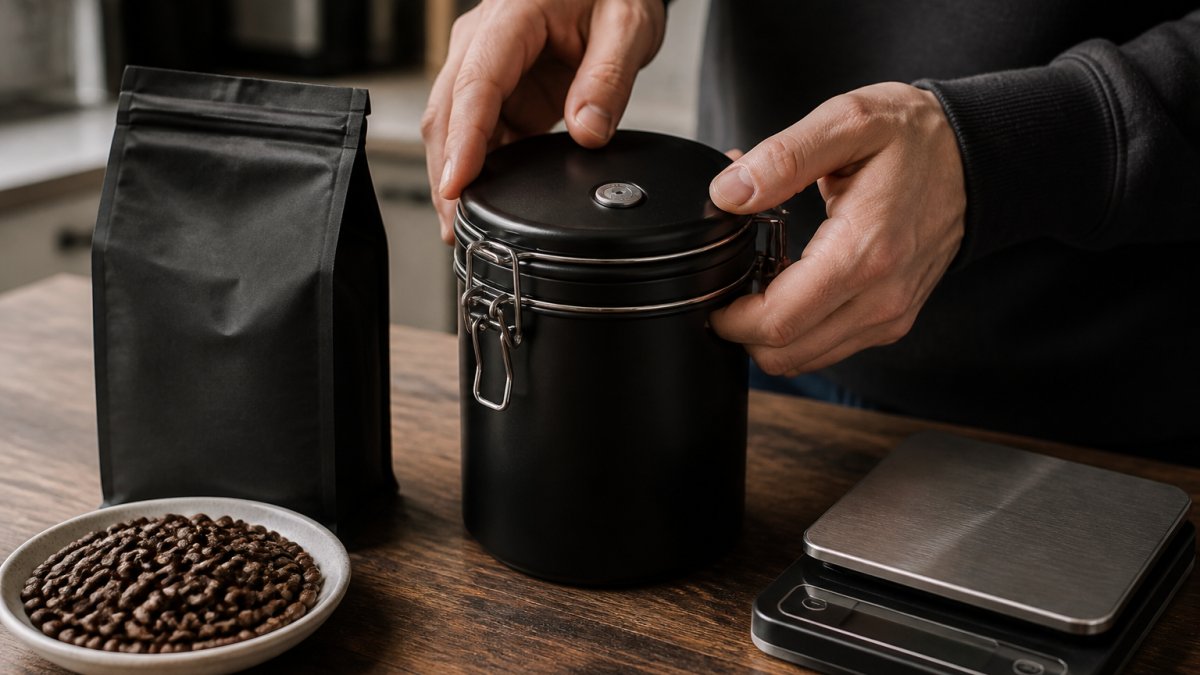
The best container for coffee beans is an airtight, opaque one that blocks light and seals out oxygen. Beyond that, the options split into a few clear types, and each suits a different routine. What most guides skip is the decision itself: how to pick between them based on how you actually drink coffee.
Switchyard Blend Medium-Dark Roast Coffee 12 oz →
Match the Container to Your Consumption Rate
The single most useful rule: size the container to the amount of coffee you'll finish in about two weeks. A one-pound bag of whole beans fills roughly a quart-sized canister, and that's the right target for a household brewing one or two cups a day. If you brew more, buy a larger canister or split the bag into two smaller ones so you're only opening one at a time.
Every time you open a container, you exchange the headspace air for fresh oxygen. A large container that's mostly empty means more air to displace each time you scoop. A container that's nearly full, or one you refill in small batches, minimizes that exchange. This is why single-dose tubes and small canisters outperform a big jar for anyone drinking slowly.
Opaque vs. Clear, Valve vs. No Valve
Opaque vs. clear. Light degrades the oils on the bean surface, and sunlight is the worst offender.
One-way valve vs. no valve. A one-way valve lets carbon dioxide escape during degassing without letting oxygen in. It matters most in the first week or two after roast, when beans are still releasing gas.
Gasket quality. The seal is what does the work.
Vacuum-sealed canisters. These pull air out of the container, which sounds ideal, but you have to reseal every time you open them, and some models are fussy about getting a full seal.
Single-dose tubes. These hold one brew's worth of beans each. They're the best option if you want near-zero oxygen exposure, and they pair perfectly with the freezing protocol above.
| Container Type | Blocks Light | Blocks Air | Best For |
|---|---|---|---|
| One-way valve canister | Yes | Yes | Daily use, 2-4 week supply |
| Vacuum-sealed canister | Yes | Yes | Slower drinkers |
| Ceramic with gasket | Yes | Yes | Countertop storage |
| Single-dose tubes | Yes | Yes | Freezing, precise portions |
| Original bag, rolled | Partly | Partly | Short-term only |
What most guides miss is that the original sealed bag with its one-way valve is genuinely good storage for the first week or two. You don't need to transfer beans on day one.
Coffee Beans Storage Mistakes That Kill Flavor
The biggest storage mistake is the refrigerator. Many people assume cold equals fresh, but a fridge is a humid, odorous place, and coffee absorbs both.
Here's what to avoid:
- Storing in the fridge: moisture and food smells seep into the beans
- Clear jars in sunlight: light breaks down the oils
- Grinding the whole bag at once: ground coffee stales in days
- Keeping beans near the stove: heat speeds up staling
- Buying more than you'll use in a month: even perfect storage has limits
- Opening the bag daily to smell it: every open releases aroma
A common mistake is buying a big bag to save money, then watching the last third go flat. Unless you're freezing portions, buy what you'll brew in two to four weeks.
Storage by Freshness Stage and Household Conditions
Your storage plan should change as the beans age, and the clock starts at the roast date, not the day you open the bag. A bag roasted three days ago needs different handling than one roasted three weeks ago. Here's how the advice shifts across the freshness curve.
A Roast-Date Timeline
- Days 1-3 (just roasted): Beans are degassing heavily and flavors are still settling. Leave them in the original bag with its one-way valve, or in a valve-equipped canister, and let the gas escape. Sealing them in a fully airtight jar with no valve can trap pressure and stale them faster.
- Days 4-14 (peak window): This is when most brews taste best. Move beans to an airtight, opaque container and use them daily. For espresso, many roasters suggest waiting a few days after roast; for pour-over and drip, beans are usually ready sooner.
- Weeks 3-6 (fading): Aroma is declining but the coffee is still good. This is the point to freeze whatever you won't finish within the next week or two, using the portioning protocol above.
- Past six weeks: Noticeably stale for most brewing methods. It's still fine for cold brew, where bold, sweet flavors mask fading, or for a milk-heavy drink where the coffee is a supporting note.
A common pattern is that people judge freshness by the "best by" label, but that date often reflects packaging and distribution, not roast date. Look for a stamped roast date and buy from roasters who print one.
Adapting to Your Kitchen
Climate and household conditions change which enemy matters most.
- Humid kitchens: Moisture control is the priority. Airtight sealing is non-negotiable, and you should avoid transferring beans between containers more than necessary. Keep the container closed between scoops and don't leave the lid off while you grind.
- Hot homes or sunny kitchens: Heat and light do the damage. A dark, interior cabinet beats a countertop jar every time, and keeping beans away from the stove, oven, or a sunny windowsill matters more than the container's material.
- Limited pantry space: If you can't dedicate a cool, dark shelf, freezing portions is the better answer. A freezer holds temperature steady and blocks light, which solves two problems at once.
- Frequent container opening: If several people scoop from the same bag, portion into smaller containers so each opening exposes less coffee to air. Single-dose tubes work well here.
A Freshness Test You Can Run at Home
You don't need lab equipment to check whether your storage is working. Brew a cup from your stored beans next to a cup from a freshly opened bag of the same coffee, and taste them side by side. If the stored cup tastes flat, papery, or dull, your storage method needs a fix. If the two cups are close, your routine is doing its job.
Frequently Asked Questions
Should coffee beans be stored in an airtight container?
Yes. Oxygen is the main driver of staleness, so an airtight coffee storage container limits how much air reaches the beans between brews. Look for a container with a one-way valve if you plan to store beans within a few weeks of roasting, since it lets carbon dioxide escape without letting oxygen in. Keep the container in a dark pantry away from the stove, and skip the clear glass jar on the windowsill, since light speeds up flavor loss.
Is it better to store coffee beans in the fridge or freezer?
The freezer wins over the refrigerator for anything you won't finish within a couple of weeks. Fridges cycle through temperature fluctuations every time the door opens, and the humidity inside pulls moisture into the beans. If you freeze, portion beans into single-use bags or tubes, squeeze out the air, and only thaw what you'll brew that day. Never refreeze beans you've already brought to room temperature, since the repeated freeze-thaw cycle pulls condensation onto the surface.
How long do coffee beans stay fresh after roasting?
Peak flavor lands roughly 4 to 14 days after the roast date for most medium and medium-dark roasts. After about 4 to 6 weeks in a sealed bag at room temperature, whole beans start tasting flat and papery, though they stay safe to brew well past that. Ground coffee loses aroma far faster, often within a week, because the increased surface area exposes more oils to oxygen. Check the roast date on the bag, not the best-by date, to judge freshness.
How can you tell if coffee beans have gone stale?
Stale beans smell dull and cardboard-like instead of sweet or roasty, and they lose the visible sheen of oils on darker roasts. A quick freshness test: drop a few beans in hot water. Fresh beans release carbon dioxide and the water bubbles; stale beans barely react. In the cup, stale coffee tastes flat, papery, or bitter without sweetness. If your beans fail that test but you paid for specialty coffee, store the next batch in an airtight container away from heat and light.