

Table of Contents
- Why Regional Coffee Roasters Beat Big National Brands on Freshness
- Flavor: Small-Batch Roasting vs Industrial Production
- Single-Origin vs Blended Coffee: Which Fits Your Brew
- Coffee Storage Best Practices for Peak Flavor
- Brewing Method Compatibility: Matching Beans to Your Setup
- Price, Value, and Convenience: What You Actually Pay For
- Frequently Asked Questions
Last Updated: September 28, 2026
Why Regional Coffee Roasters Beat Big National Brands on Freshness
Regional coffee roasters typically roast in small batches and ship within days of roasting, while big national brands roast in massive volumes and distribute through warehouses where bags can sit for months before purchase. That gap is the whole story. At Mainline Roastery, we roast to order and ship the same day, which is why the bag on your counter tastes like the beans were roasted this week, not this season.
The Freshness Timeline: From Roaster to Your Cup
Freshness decays on a clock, and the clock starts at the roaster, not the store shelf. A bag roasted Tuesday and shipped Wednesday reaches peak drinking window within the first two to three weeks. The same beans routed through a distribution center and a grocery backroom may already be a month or two old before they hit your grinder. For anyone comparing regional coffee roasters to national brands, that timeline is the first thing to check.
Why Coffee Roast Date Importance Changes Everything
The coffee roast date importance cannot be overstated: it is the single most useful number on a bag. Unlike a "best by" date, a roast date tells you exactly how long the beans have been off the roaster. Caffeine and flavor compounds begin degrading from day one, slowly at first and faster once the bag is opened. If a package shows only a best-by date, that is a signal the roaster is not prioritizing transparency.
Flavor: Small-Batch Roasting vs Industrial Production
Small-batch roasting gives a roaster room to adjust time and temperature for each bean, which is how distinct flavor profile notes survive the process. Industrial roasting optimizes for volume and consistency across millions of pounds, and that scale tends to flatten complexity. The result is coffee that tastes reliably the same, but rarely tastes like much.
Drum Roasting vs Industrial Roasting
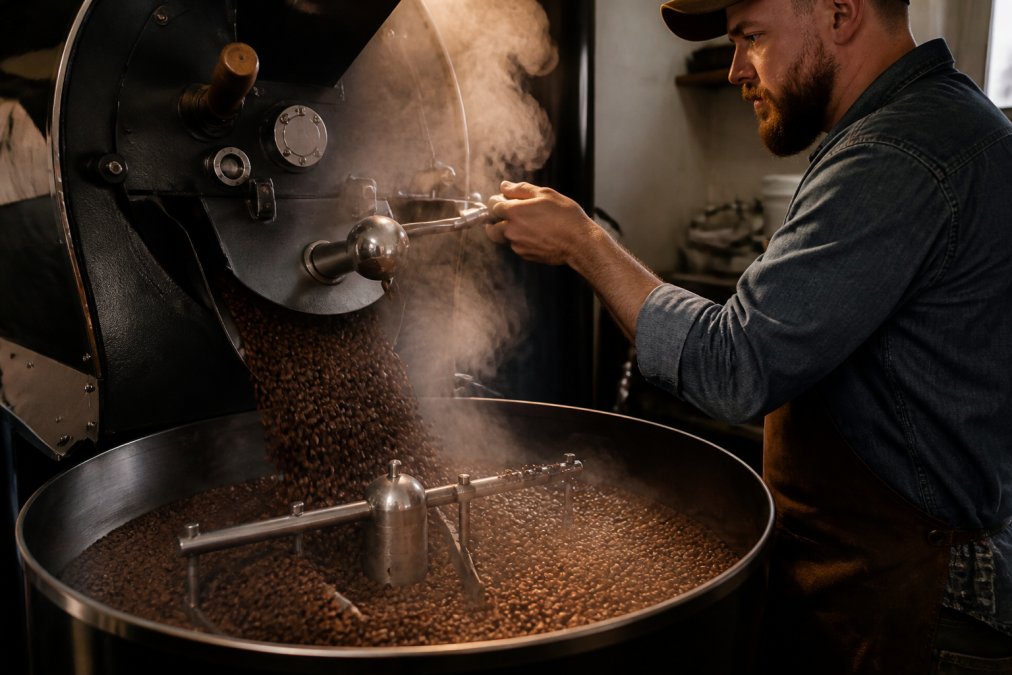
Drum roasting is the traditional method: beans tumble inside a heated rotating drum, developing body, acidity, and aroma through direct contact and airflow. Industrial roasting often relies on large fluid-bed or high-volume systems built for throughput. Neither approach is inherently bad, but drum roasting gives a small roaster the technical control to hit a target roast level precisely, batch after batch.
Arabica vs Robusta and What It Means for Taste
Arabica beans generally carry more acidity, sweetness, and nuanced notes, while Robusta brings higher caffeine and a heavier, more bitter profile. Many commercial supermarket brands blend in Robusta to cut cost and add punch. Single-origin and specialty coffee producers usually lean Arabica for clarity. Neither is wrong, but if you want aftertaste and complexity, Arabica-forward beans are the safer bet.
Single-Origin vs Blended Coffee: Which Fits Your Brew
Choose single-origin when you want to taste one place, and a blend when you want consistency across brewing methods. Single-origin coffee comes from one region or farm, so its flavor shifts with harvest and processing. Blends combine origins to build a repeatable cup. Mainline Roastery's Switchyard Blend is a medium-dark roast built from Caturra and Ethiopia Heirloom beans, with notes of bittersweet chocolate, toasted marshmallow, candied orange, and praline.

| Option | What You Get | Best For |
|---|---|---|
| Single-origin | One region, distinct notes | Tasting a specific place |
| Blend | Consistent cup, layered body | Daily brewing, espresso |
| Supermarket blend | Lower cost, uniform taste | Convenience buyers |
Specialty Coffee Association standards and research
Coffee Storage Best Practices for Peak Flavor
Here is the uncomfortable part of the freshness story that most comparisons skip: a regional roaster can hand you beans two days off the drum, and you can still end up drinking stale coffee by week three if your storage routine works against you. The roaster controls the first half of the freshness clock. You control the second half.
Why Oxidation Is the Real Clock, Not the Roast Date
Once beans leave the cooling tray, two things start happening at once. First, degassing: roasted beans release carbon dioxide for days after roasting, which is why a freshly opened bag puffs up and why a pour-over of day-one beans can bloom violently and then taste flat and sharp. Second, oxidation: oxygen reacts with the oils and aromatic compounds on the bean surface, and those compounds, the ones responsible for the fruit, chocolate, and floral notes you paid a premium for, fade first.
The Storage Mistakes That Erase a Freshness Advantage
Most practitioners find that a handful of habits do the most damage:
- Leaving beans in the original bag with a folded clip. One-way degassing valves are designed for shipping, not for daily opening and closing. Every reseal pulls in fresh oxygen. Transfer to an airtight, opaque canister once the bag is open.
- Storing in the refrigerator. The fridge cycles through temperature and humidity swings every time the door opens, and coffee oils readily absorb the odors of whatever else is in there. A cool, dark cabinet beats the refrigerator for daily-use beans.
- Freezing incorrectly. Freezing whole beans in a truly airtight, vacuum-sealed container can extend shelf life for long-term storage, but pulling a bag in and out of the freezer introduces condensation on the beans each time. If you freeze, portion first and thaw once.
- Grinding ahead. Ground coffee has far more surface area exposed to oxygen than whole beans, so it stales dramatically faster. Grind just before brewing, every time.
- Buying more than you will drink. A two-pound bag at a great per-ounce price is a bad deal if the last third goes stale before you finish it. Match your purchase size to your actual weekly consumption.
A Practical Freshness Window
A common pattern among roasters and home brewers is a peak drinking window that runs roughly from about four to seven days after roast (once most degassing has settled) through about three to four weeks after roast for whole beans stored well. Ground coffee compresses that window to days, not weeks. This is the practical reason small-batch roasters ship quickly and why coffee storage best practices matter as much as the roast date itself: the advantage only survives if you protect it.
Switchyard Blend Medium-Dark Roast →
Brewing Method Compatibility: Matching Beans to Your Setup
Most comparisons stop at the bag. The gap nobody covers is what happens after the bag is open: the same beans that taste bright and layered at a regional roaster can taste muddy or thin at home if the brew method and the roast profile are working against each other. Small-batch roasts are not automatically better in every brewer, they are more sensitive to how you brew them, because there is more flavor to lose.
Why Roast Profile and Brewer Have to Match
A lighter roast developed for clarity retains more of the bean's origin character, the acidity, the fruit, the floral notes, but it also extracts differently than a darker, more developed roast. Mass-market beans are typically roasted darker and more uniformly to survive long shelf life and inconsistent brewing, which is why they taste the same whether you use a drip machine or a French press. Small-batch beans reward matching:
- Pour-over (V60, Chemex, Kalita): Best for light and medium-light roasts where you want to taste origin. The paper filter strips oils and body, so a delicate, high-acidity bean shines. Use a medium-fine grind and a slower pour. A dark, oily mass-market roast often tastes hollow here because there is little acidity left to carry the cup.
- French press: Best for medium and medium-dark roasts with more body. The metal mesh lets oils through, so a bean with chocolate and caramel notes, like a medium-dark blend, tastes full and round. A very light roast can taste underdeveloped and grassy in a press if the water is not hot enough or the steep is too short.
- Auto drip: Forgiving, but it punishes stale coffee. Because drip runs a fixed time and temperature, old or poorly degassed beans extract unevenly and taste flat. This is the brewer where the freshness gap between small-batch and supermarket beans is most obvious.
- Espresso: Demands consistency. A blend built for repeatability, like a medium-dark blend of Caturra and Ethiopia Heirloom, pulls a sweeter, more stable shot than a single-origin that shifts with every harvest. Single-origin espresso can be excellent, but it requires dialing in the grind almost daily as the beans age.
- Cold brew: Coarse grind, long steep, low acidity. Medium and medium-dark roasts with chocolate and nut notes work best; very light roasts can taste tea-like and underwhelming after a twelve-hour steep.
A Starting Point You Can Adjust
Start with a 1:15 coffee-to-water ratio by weight, a grind sized to your brewer, and water just off a boil for lighter roasts or slightly cooler for darker ones. Then adjust one variable at a time. If the cup tastes sour or thin, grind finer or extend the brew. If it tastes bitter or dry, grind coarser or shorten it.
Specialty Coffee Association brewing standards and research
Price, Value, and Convenience: What You Actually Pay For
Regional roasters usually cost more per bag than commercial supermarket brands, and the difference buys freshness, transparency, and quality control. A 12 oz bag of Switchyard Blend runs $17.99, roasted to order and shipped the same day. Supermarket coffee is cheaper and easier to grab, but you trade roast date certainty and bean quality for that convenience.
| Factor | Regional Roasters | Big National Brands |
|---|---|---|
| Roast date | Printed, recent | Often best-by only |
| Batch size | Small-batch | Industrial volume |
| Sourcing | Often traceable | Rarely disclosed |
| Price | Higher per bag | Lower per bag |
| Convenience | Shipped to you | Available in stores |
USDA guidance on coffee and agricultural sourcing
Frequently Asked Questions
How do I know if my coffee beans are actually fresh?
Check the roast date on the bag, not the best-by date. Regional coffee roasters print the exact roast date because their beans move fast. If a bag only shows a best-by date months out, it was likely roasted long before it reached the shelf. Fresh beans also smell sweeter and more aromatic when you open the bag, and they bloom visibly when hot water hits them during brewing.
Does the roast date really affect the flavor profile of coffee?
It does. Coffee peaks roughly 4 to 14 days after roasting, when degassing has slowed enough for stable extraction but the aromatic oils are still intact. After about 4 to 6 weeks, oxidation takes over and the cup tastes flat, papery, or stale. Regional roasters who ship within days of roasting give you a wider window to brew at peak flavor than supermarket bags that sat in a distribution center.
Is single-origin coffee always better than a blend?
Not always. Single-origin beans highlight one region's specific flavor profile, which suits pour-over and lighter roasts. Blends combine origins for balance and consistency, which works better for espresso, drip, and milk drinks. The right choice depends on your brewing method and whether you want a distinct regional character or a dependable everyday cup.
How should I store coffee beans to keep them fresh?
Keep beans in an opaque, airtight container at room temperature, away from light, heat, and moisture. Do not store them in the fridge or freezer unless you seal them properly and use them within a few weeks. Buy in smaller quantities so you finish the bag while it is still within its peak window, and grind right before brewing to preserve aroma and oils.
The real challenge is not finding coffee; it is finding coffee that still tastes fresh when it reaches your kitchen. Mainline Roastery roasts to order and ships the same day, offers blends and single-origins, and delivers bold flavor with transparent sourcing. Get started with Mainline Roastery and taste what a genuinely fresh roast does for your morning cup.